Friday, September 26, 2014


elsewhere

a choreographic work by Heidi Strauss


    DANCEWORKS ADELHEID - Production Photos by Jeremy Mimnagh
In the world premiere of Heidi Strauss’s elsewhere, the complex realm of Affect Theory is given heightened attention as dancers involve themselves in elaborate displays of individual and group excitability and restraint. Perhaps some of the most intriguing and enlightening textual moments occur when one of the dancers stops, mid movement, and attempts to describe what it is like…
The overwhelming ephemeral question, to which there can be no definitive answer, is pondered in a delicate, somewhat staccato manner by dancer/performer Molly Johnson as she delivers a series of lines with a kind of self-assured uncertainty. Her verbal expression becomes a beautiful, fragile, testimony to the ways in which life and movement intertwine in mysterious, volatile, at times bewildering ways. 
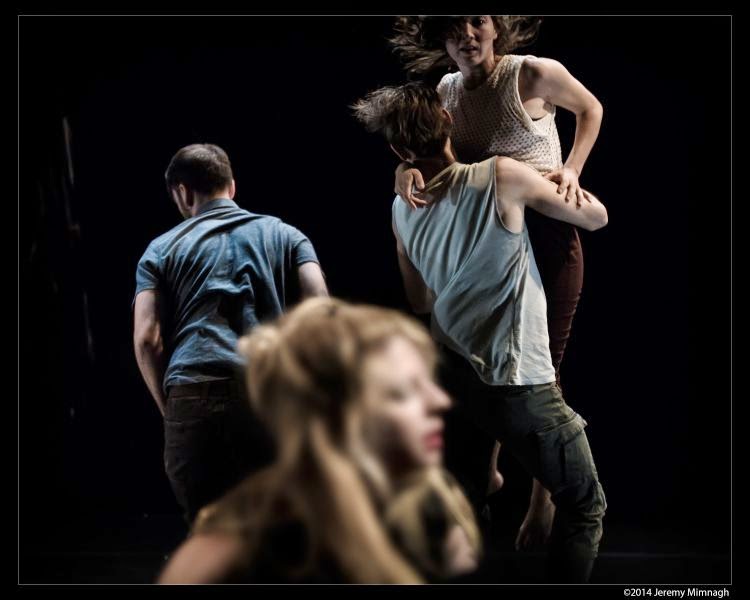
This ménage of varied movement and intermittent verbal expression is at its best in elsewhere when it finds specific dance phrasing that allows the dancers to come together and separate in vivid, at times explosive encounters. The touch of an arm or the bend of an elbow, in the hands of dancers like Danielle Baskerville, Miriah Brennan, Luke Garwood, Molly Johnson, and Brendan Wyatt become tightly conceived, idiosyncratic gestures that are an extreme pleasure to watch.

Music by Jeremy Mimnagh, although evocative and punctuating, tends to over syncopate some of the rhythms, creating a frequently predictable sense of mood that overstates otherwise contained and self-evident gestures. This may be an attempt to illustrate the connected patterns of physical memory as they manifest themselves through the 'affect' of past corporeal experience. But it tends to over connect and simplify, when a contrasting, more dissonant soundscape might deliver more ‘affective’ bodily configurations. Nevertheless, the music does possess a powerful luminosity as it mixes with the choreography. Mimnagh’s accompanying light filled, softly flickering projections, displayed on Duncan Johnstone’s large painted screens, create an effective abstract counterpart to the shimmering patterns of movement and emotion.

Focused eyes and tense facial expression play a significant part in the overall balance of physical/emotional lyricism and skeptical interplay as the ensemble appears acutely aware of their sensory connections to each other - connections that extend themselves through style and tone among a series of five deeply committed onstage bodies.
In her programme notes Heidi Strauss explains how affect theory has influenced elsewhere, and her perceptions of life and movement in general.

“I now see affect as a part of everyday life, intrinsic to the reality of any moving body, from the woman walking her dog, to the man doing Tai-Chi every morning, to the kids kicking the ball in the park across the street. And these involuntary responses are built on everything we have experienced until this point - not held in check by the boundaries we might think we are placing around our own personal histories.”
Desire, appetite, pleasure, pain, and sorrow are basic tenets of Affect Theory, and, obviously, the experience of being alive in the world among other bodies. elsewhere, in many ways, is a simple expression of the complex ways in which bodies respond to each other over time. Strauss has dared to examine these connections in a sixty-minute meditation that excites and moves the emotions of the viewer and the dancer in a pleasurable and powerful manner. And yet there are moments when the overall choreographic narrative slips and becomes too akin to everyday experience in a seemingly pointless and random manner. This may very well be an expression of affect theory. But when it is reduced to a group of dancers chasing each other across the stage, it becomes superfluous and distracting.

In sharp contrast, when Brendan Wyatt takes part in the meticulous chaos of flailing arms centre stage, affect becomes explosive and breathtaking. One witnesses the hit and miss spectacle of a dancer so in control of the uncontrollable that we sit in awe that he has not knocked his own head off in the overwhelming process. Or when Wyatt and Luke Garwood embark upon a beautiful and aggressive  pas de deux, with lifts and anguish in tow, the spectacle is both powerful and elegant. Or when Molly Johnson, Miriah Brennan, and Danielle Baskerville attend to their male cohort's aggression, creating delicate and connective gestural tissues between fingers limbs and torsos, this is where Strauss’s take on affect theory excels.
Ultimately, affect is dance and dance is movement, and elsewhere suggests that we are always in another place - past, present, and future - simultaneously - as we move among each other, creating the elusive patterns or our breath taking selves. With a slightly more streamlined (forty five to fifty minutes) take on the overall phrasing of this one hour piece, whereby music and movement are given less rambling moments of punctuation and inessential synchronicity, elsewhere could begin to exist more successfully somewhere between theatre and dance. Textual moments could be expanded and some of the daily, walking rhythms could be excised. The one on one couplings could be more balanced between genders, rather than a gorgeous yet somewhat predictable display of masculine and feminine paradigms. This could enable elsewhere to live everywhere - thereby allowing it to breathe more fully within the affective modes of patterned uncertainty that human existence and the flesh filled glory of bodily contortions are inherently prey to.
elsewhere runs at the Harbourfront Centre Theatre until September 27th, 8PM

Monday, September 1, 2014


SPOILER ALERT - THE HUNDRED FOOT JOURNEY IS A FUSION OF MANY CULTURAL AND CULINARY STYLES, ALL ENTERTAINING TASTY SENTIMENTAL AND ANNOYING….

It has been a very long time since I intensely disliked a film that I was so thoroughly engaged and entertained by. I cried (laughed a little) all through it, but I was exhausted from an eight hour bus and train journey from Quebec the day before so I would have cried at the drop of a hat. By the end of the film, tear stained and enraptured by the irritation of incessant and predictable romantic play, I almost wished I had saved the thirteen dollars and just dropped my hat and wept.

And the business class boozy train journey included a lovely conversation with a woman who shared her assessment of Canadian regional tastes based on the kind of drink we order on trains. I ordered rum and coke, white wine, and then a shot of Baileys as fond homage to my white trash heritage. She ordered scotch, wine, and port - and had just seen the Faberge exhibit in Montreal. So I was feeling a bit critical of the decorative, culinary and libational arts.

Similar to the post-colonial colonialisms of The Best Exotic Marigold Hotel, The Hundred Foot Journey is a charming, romantic comedy about rampant xenophobia, marked by a particularly ugly and violent hate crime part way through. From a meta-theatrical point of view one might entertain the casual desire to examine the cinematic politics of casting a famous British actress as a French woman in possession of a very uneven accent - a French woman whose race politics make an about face after she has consciously taken part in the same forms of cultural xenophobia as some of the townsfolk.

By dismissing a young French man for similar hate crimes the character becomes a sympathetic maternal force by default. By the end of the film it isn’t too difficult to tell what she prizes more, a Michelin star or a Michelin award winning man. She needs and wants both and does everything she can to both lose and regain their attentions. The Hundred Foot Journey becomes a parody of culinary and cultural traditions and makes high-end French cuisine look like decorative appetizers alongside the more lavish Indian dishes. And then of course fusion, the ever-popular contemporary form of mixed cuisine, provides for a metaphoric grand narrative that ultimately makes all of the people happy all of the time.

Helen Mirren is always gorgeous and mesmerizing in her roles. It is hard to take your eyes off of her during this two-hour culinary spectacle. But when she speaks her French is crisp and strained, if not somewhat convincing at times - but at other times she is just Helen, and the British sounds become embarrassing as they seep through, providing an unpleasant reminder that Catherine Deneuve would have been far more convincing in the part. Om Puri, as Mirren’s “almost boyfriend” rises above the material at hand and gives a very strong performance as the self-willed paternal force who brings the maternal origins of his family’s journey full circle, and honours tradition as he embraces change.
My favorite romantic narrative was the movement from the village to Paris, where the prized young chef gets a new suave hairdo and grows a bit of light sexy facial hair. My reading of this fashion move pushes all culinary interests to the side and tells me that the beautiful young female chef had to send her male competitor to the city in order to pretty himself up before she could have carnal relations with him in the kitchen. But I am being ridiculous about the sublime here and know in my heart of hearts that true love is blind when it comes to physical attractiveness, tra la. The young chef comes back to his kitchen collaborator looking sleek, scruffy, debonair and irresistible all at once - when he had begun the film as a wide-eyed, beautiful boy aspiring to the heights of cooking genius that his mother has instilled in him. Damn!!! If Disney, Oprah, and Spielberg hadn’t made the film we might have been treated to some fabulous fusion sex and the dishes would have been way dishier.

The acting is lovely, the scenery is divine, and the empty country road between the two restaurants is harrowing in its emptiness as couples nonchalantly wander across a hundred foot stretch of cultural mayhem and make one wonder whether a Stephen King version with a ghost driven monster truck filled with croissants and lentils might have made the opening line of the film a little richer and less simplified - “We cook to make ghosts.” Releasing the spirits of food, cultural difference, and romantic intrigue becomes a garden of earthly delights, but unlike the famous painting by Hieronymus Bosch, these delights lack the relentless presence of hell on earth. There is hell, of course, but it is all so Disney’fied. So go see it. Like me, you may laugh, cry and crave South Asian cuisine all through it.

                        And the limp asparagus scene was priceless.

Sunday, May 25, 2014


Judith Thompson, as a playwright and a performer, has the ability to take hold of her audience with a single line and hold them in her grasp from beginning to end. In Watching Glory Die the moment she walks onstage her physical and vocal presence begins to sharply delineate, with a delicate balance of subtlety and smoldering rage - line by line, movement by movement - the emotional complexity of three characters trapped within the parameters of an institutional setting that has them all at odds with all they believe in and all they desire.

The life force that surrounds Glory is simultaneously disturbing and poignant as the text and the performance give the characters a kind of mysterious route through their response to the unyielding journey they have been entrapped by - made all the more powerful by Ken Gass’ direction, Debashis Sinha’s sound, Astrid Janson’s set & costumes, André de Toit’s  lighting, and Cameron Davis’ Projection Design - adding an indelible cinematic flare that gives the prison scenes a harrowing atmosphere.

As Glory, her mother, and a prison attendant, Thompson crafts distinct personas that take spectators in at the outset with finely crafted vocal nuance and intricate stories that compose a beautiful lyric journey to hell and back. And yet the final destination, as presented in the title of this one-woman tour de force, has Glory lost in the machinations of a system that demands she be pathologized beyond recognition. The rules and regulations leave no room for the real Glory to be released from her cold, inhuman surroundings.

Thompson’s words and her performance do not make it easy for audiences to unravel the characters they are presented with, and this is the result of a brilliant playwright’s ability to create tragicomic pathos and hard won sympathy within three separate women through complex characterization. Loosely based on the story of Ashley Smith, a nineteen year old who lost her life when she was on suicide watch at the Grand Valley Institution for women, Thompson’s seventy-five minute script is a well-balanced argument against the strictures that handcuff people to rules and regulations that fail to allow any real, life saving interaction. 

Emotional intensity mixes with a paradoxical commingling of the disturbing and the comforting as Glory’s mother reminisces and tries to bring her daughter back through an almost eerie form of nostalgic utterance. Supported by the  prison attendant’s own working class struggles, and Glory’s metaphoric battle with Crocodiles, the text and performer create a triumvirate of haunting journeys all connected by their tie to Glory - lost, found, and lost again. 

Darkly comic moments around class and idiosyncratic imagery touch down here and there and give the overall experience a strong layered sense of Thompson’s sensitivity to the brutal comedy and tragedy that marks so many peoples lives. Although the ending wanders a little, and tends to have a an estranged sense of where to finally land, this may very well be the result of  a theatrical and a life experience that becomes a battle - to the death - with maddening tears, heart wrenching loss, and life numbing regulatory control  - all conspiring to reflect and refract the sheer impossibility of it all - an impossibility that cost Ashley Smith an entire lifetime of experience.

Ultimately, Watching Glory Die becomes a testament to the failure of certain social structures as they confine human beings within impossible circumstances. The whole notion of an entity named Corrections Canada becomes a sad, frustrating, and tragic exercise in opposing forces that fail to correct a tightly knit maze pf psychological imprecision long enough to serve a single human being in pursuit of the truth buried beneath a pathologically asphyxiated and institutionally disconnected identity.

Canadian Rep Theatre's world premiere production of Judith Thompson's Watching Glory Die, until June 1 at Berkeley Street Theatre Upstairs


Monday, May 12, 2014


INDEPENDENT CREATORS COLLECTIVE AT 
THE THEATRE CENTRE

present

BUSINESS AS USUAL 
RALPH AND LINA 
&
DEATH MARRIED MY DAUGHTER
The current triumvirate of theatrical delight at the newly opened Theatre Centre is a marathon of intense theatricality that culminates in a wild ride through a macabre nostalgic ShakesPearean freak show. 


Beginning with a Kafka'esque corporate melange of movement, ruthless backstabbing and quirky heteronormative dialogue about wives and other objectified modes of desire, Business As Usual is beautifully performed by Victor Lukowski, Adam Paolozza, and Nicolas Di Gaetano. All three actors create mesmerizing physical presence as they weave an ensemble performance seamlessly directed by Lukawski. The script itself plays slight second banana to the cleverly choreographed use of props and set pieces, highlighted by an unforgettable sex scene between two desk lamps. 

For the most part text and physical prowess produces an erie and intriguing look up and down the corporate ladder. But there are times when the dialogue and rapid fire verbal warfare could use more textual nuance and character development. But at the end of this hour long barrage of relentless interrogation one is left with a medium and a message that is both haunting and engaging form start to finish.

ZOU Theatre Company

A surreal glance into the seedy underbelly of big business in a post -crash world, created by the company and directed by Viktor Lukawski (seen in Tarragon/TheatreRUN’s The Double and Old Trout Puppet Workshop’s Ignorance). A once-successful corporation is flying off the rails: the employees are running wild and the execs are drowning in the turbulent waves of their own excess. To the outside world, all is as it should be, but behind closed doors, a noose is tightening, tensions are rising, and the coffee pot is overflowing as this corporate Twilight Zone reaches unsustainable heights of madness. This is PTSD for the financial class. Lukawski is joined on stage by fellow co-creators Adam Paolozza (director/performer of The Double, Dora Award for Spent) and Nicolas Di Gaetano (seen in Ignorance, and the award winning Countries Shaped like Stars).


Ralph and Lina is a heartwarming, sharply physical performance piece for two characters that picks up on the great physical skill of the first offering of the evening. Dan Watson and Christina Serra have created a near mime like environment, with dialogue, with the support of writer/collaborator Michele Smith. The end result is a joyful, frequently up and down, near operatic story of struggling immigrants whose commitment to each other, and resourcefulness in a new and strange environment, is artfully reflected in the enormously engaging direction. Props, costumes, and set pieces conspire to create a truly startling and rewarding journey from one continent to another, from comic emotional mishap to charming interactive domestic bliss that brings the audience full circle in this delightful, timeless tale. Similar to the narrative of Business As Usual, there are times when the dialogue in Ralph and LIna might have investigated more complex notions surrounding immigrant experience. But the innocence and charm of the story win out as the characters capture each others hearts in the midst of a chaotic sequence of life changing events.

Ahuri Theatre

Produced by Dora Award winning Ahuri Theatre, is written by Michele Smith and real life husband and wife, Dan Watson (writer/director of Ahuri’s A Fool’s Life which earned six Dora nominations and won Outstanding Sound Design) and Christina Serra. The rough and tumble romance tells the true story of Serra’s grandparents – two Italian lovers and their struggles to stay together in the face of World War Two, forced immigration and old age. In the vein of early Fellini (La Strada), the award-winning creative team dives into their own family histories to explore notions of dependence and separation in a passionate acrobatic comedy that radically reinvents the modern melodrama. The play is directed by Smith and is performed by Watson and Serra.


Perhaps the most bizarre and startling production, placed wisely at the end of a long evening of unique theatre, comes in the form of two gifted performers of the clownish, stylized bouffant tradition. Nina Gilmour and Danya Buonastella are able to to push thier audince to the limits of expectation and onstage peculiarity, ultimately winning us over by the end through sheer physical determination, incredibly evocative makeup and costume, and an enormous charm and presence in the face of the truly gorgeous and the utterly grotesque. At one point near the end two spectators left the theatre during a particularly challenging baby scene. These challenging, uncomofrtable moments are brilliantly balanced as feminist strains filter in and out and provide the duo with the opportunity to reveal a riveting Ann Coulter inspired monologue that tears, with parodic brilliance, at right wing non-sensibility with clever and seething abandon. 
The recurring Ophelia/Desdemona theme gives the characters a strong foundation of nostalgia to work from, and yet, like all three offeings of the evening, lacks some narrative clarity that might have grounded them more firmly within their back stories. But once again, like the other two plays presented, the sheer physical brilliance of the performers and the ingenuity and genius of the direction brings it all to life in an action packed evening of unique and engaging physical theatre.
Play it Again Productions

Written by Danya Buonastella, Dean Gilmour, Nina Gilmour and Michele Smith (the latter three husband, daughter and wife who all performed in Theatre Smith-Gilmour’s Dora-nominated As I Lay Dying). This bouffon-inspired satire was a Patron’s Pick and held over as Best of Fringe (2013). It resurrects Shakespeare’s Ophelia and Desdemona from exile in the swamps of death to expose their “abusers” and “murderers,” and to destroy – with delight – the established values of a ‘Man’s’ society. It is directed by the Dora Award winning team of Michele Smith and Dean Gilmour and performed by recent graduates of École Philippe Gaulier: .

April 17th to May 18th, 2014 

at the Theatre Centre

1115 Queen St West

Friday, May 9, 2014


Esmeralda Enrique's recent evening of Flamenco at the Fleck Dance Theatre featured all of her signature brilliance as she continues to approach a classic form with a strong sense of history, transience, and the nostalgic, evolving  migration of bodies across cultures and continents.
full company
Accompanied by the farm labourer's songs of Eastern Cuba to the carnival atmosphere from the port of Cadiz, a powerful ensemble of dancers, singers, and musicians graced the stage with gorgeous movement and costume. Guest artist El Junco punctuated the overall evening with his lithe, fluid presence, as he took on featured roles throughout. The ensemble of women created brilliant syncopated groupings as well as virtuoso offerings that explored themes as diverse as childhood memory, aesthetic surrender and acceptance, as well as the personal histories reflected in 'daily lives, gestures, and habits.'
Junco and Gudino
Perhaps the most outstanding and consistent element of any given Enrique evening of Flamenco, becomes the simultaneous sense of a tightly woven inerplay of music, dance, and song. Although rehearsed  to the point of seamless brilliance, there is always a sense of playful, near improvisational camaraderie that wanders with graceful, at times explosive abandon across the stage and infuses the evening with a kind of a elegance, commitment, and immense skill that never fails to excite.
Pamela Briz, Paloma Cortez, Noelia La Moroch
De Idas y Vueltas did all this, and more, as the overall evening captured what Enrique calls an exploration of "the flamenco songs known as cantes de ida y vuelta." Melodies brought back from the Americas that became imbued with a flamenco accent spoke of "transmigrations of people, music, and customs" - intricate networks of cultural and aesthetic history as it has evolved over centuries of "goings and comings that determined the styles and sounds of both shores." Enrique traverses these shores with a fine blend of the personal and the universal as she infuses each choreographic offering with a joyous and committed sense of sight, sound, movement, and a fully integrated inter-cultural tapestry.


Esmeralda Enrique
photo credits: Hamid Karimi

APRIL 24-27, 2014, HARBORFRONT, FLECK DANCE THEATRE

by Sean Dixon
directed by Richard Rose

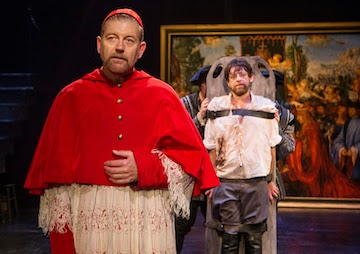
1606 and Europe is at war over God. Venice’s four strongest men are charged with transporting a holy painting across the Alps to Prague. On their way, they are set upon by Protestant zealots—their escape is attributed to a miracle. Through this mystery Sean Dixon challenges the role of faith at the dawn of the Age of Reason.

Sean Dixon’s provocative and beautifully written play, A God In Need of Help, is a timely meditation on the nature of mythic storytelling, visual representation, and humankind’s thirst for singular narrative in the face of multi-vocal gods at war with each other. A fey, sturdy young man, with a group of varied brawny fellows, carries a sacred canvas across the Alps and all hell breaks loose as this assertive gentle fellow gradually reveals that he is party to what some might consider a rather miraculous delusion. Replete with magical wine, homoerotic tension, and intersecting plot lines hinting at the entwined persecution of witches and homosexuals, this complex telling of religious conflict is an intelligent and moving interrogation of all that is holy. What appears on the surface of a sacred canvas becomes an intricate play of truth and fiction as men fight for their lives and their gods.

Direction by Richard Rose is flawless as the pivotal canvas plays a starring role. Actors are simultaneously framed by and overwhelmed with the intensity of colour and size as they struggle with the presence of a religious empire that utilized visual imagery in order to re-assert Church presence, power and practice.

A powerful ensemble cast provides a strong, cohesive playing field for the playwright’s intricate commingling of religious fervor, human suffering, and homosocial tensions wrought from camaraderie and physical beauty. Greg Ellwand’s consistently sensitive yet assertive voice and physical presence as Borromeo holds the overall canvas together, leaving him, as a primary representative of the church, to consider the singular and lonely space he is left in after an arduous struggle to determine the true nature of faith, the presence of the gods, and the miracles that attend them.

RUNNING AT TARRAGON UNTIL MAY 25TH