Thursday, August 18, 2016

Canadian Rep Theatre - DREAMS (Rêves) & TOUGH

dreams (rêves) & TOUGH!

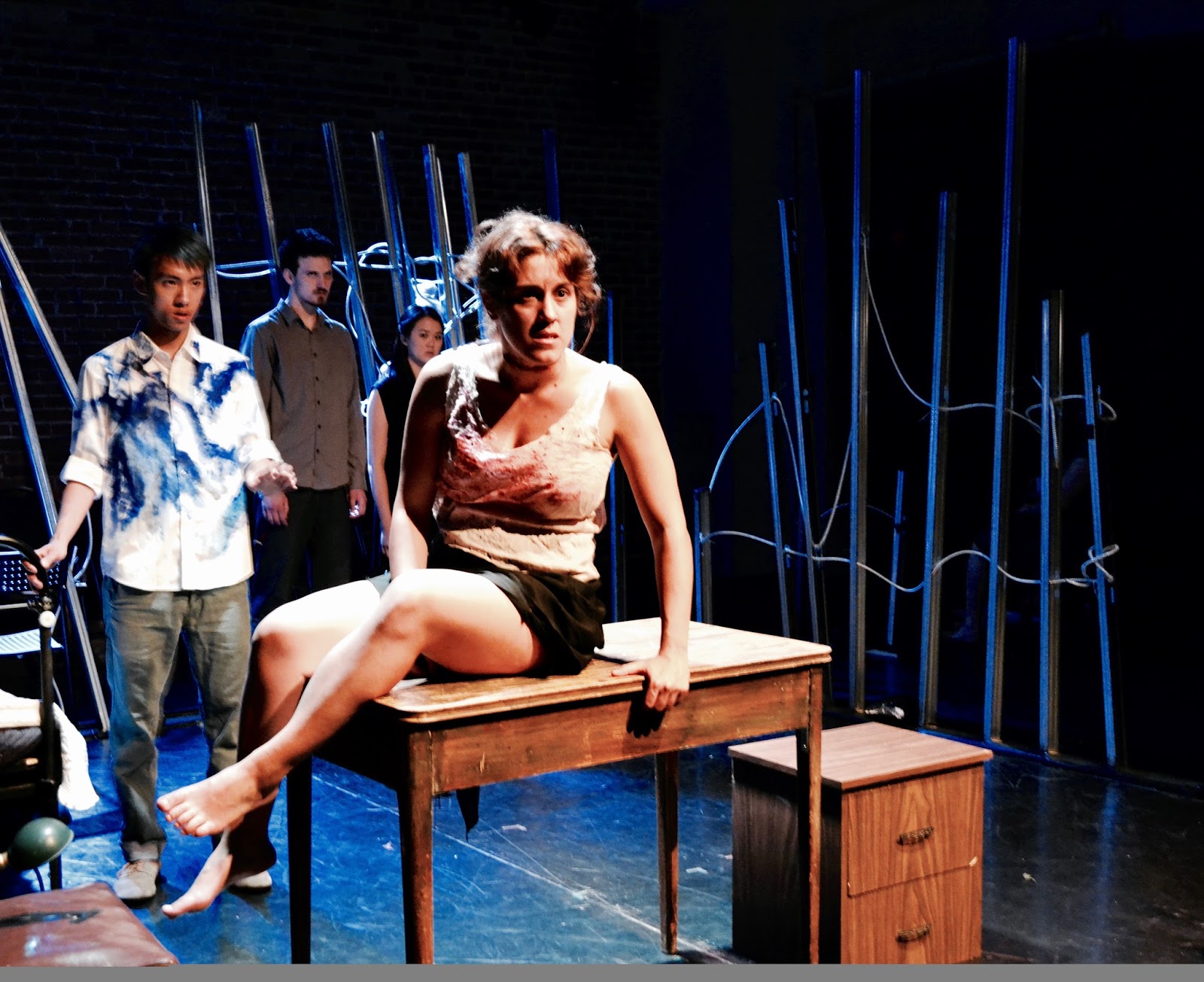
As difficult as it may be to see a parade of stereotypical attitudes between men and women cross the stage in a seventy-five minute explosion of anger, giref, and misunderstanding regarding teenage pregnancy and all its implications, George F. Walker’s 1990’s drama TOUGH! does drive home the point that there is still a lot of work to be done. In the hands of director Ken Gass, the three person play, adapted to include eleven actors playing the triumvirate of youthful hostility, becomes a powerful and disturbing array of unanswered questions that end in an open and bewildering manner - leaving the audience with their own questions to ponder.

The ensemble manages breakneck pacing and powerful performances as they race across the stage, turning the dialogue for three into a mesh of gender divided proportions. The primary weakness of the script may be that it leaves too much up to the imagination without delving into the sympathetic possibilities that the characters rant about non-stop for the entire drama, pitting young men and young women against each other without any sense of how these issues might be addressed - apart from a lot of anger and simple delineation regarding traditional gender behaviour. 

photos by Canadian Rep Theatre
(left to right) Neil Babcock, Dorcas Chiu, Erik Mrakovcic, Madeleine Heaven

The performances are incredible and complex and the blocking is a fine study in maze-like diagrams that reveal director Ken Gass and his cast as highly talented and skilled practitioners. And yet, the physical form at times transcends the somewhat undetailed social narrative of TOUGH! that never quite flies above its directorial finesse.
(left to right) Augusto Bitter, Kevin Matthew Wong, Dorcas Chiu, Madeleine Heaven, Erik Mrakovcic, Olivia Rhiannon Nicoloff, Neil Babcock

The program notes suggest that the change form a three person cast to just under a dozen reflects “Toronto’s rapidly shifting demographic” since the inception of the play in the nineteen nineties, and goes on to explain that the new casting choice creates “multiple viewpoints on the difficult choices Bobby and Tina must make.” Indeed, the diversity of race and gender does reflect a broader demographic, but the class issues and the issues of sexuality, vaguely represented in a single butch female character, tend to blur any profoundly detailed discussion of race, class, or sexuality. A lone needle that appears part way through the play tends to narrow the class focus without delving into it, creating a stereotype that is never fully unpacked.
(Left to Right - back) Madeleine Heaven, Olivia Rhiannon Nicoloff, Dorcas Chiu, Erik Mrakovcic, Augusto Bitter
(Front) Kevin Matthew Wong, Neil Babcock, Danny Ghantous

Regardless, TOUGH! is, indeed, a tough treatment of an overwhelming problem that made its impact in the nineties and may encourage further discussion close to a quarter of a century later.

dreams (rêves) by Wajdi Mouawad and translated by Linda Gaboriau, the second offering of the evening, is equally as powerful as TOUGH! as it addresses complex issues regarding loss, loneliness and ensuing anger within a world ravaged by war. The same casting choice, utilizing 11 people, creates a strong stylistic connection to the first play of the evening. And yet the poetic narrative, marked by a beautiful sense of post-modern citation, is a much stronger text as characters create a dream-like world around the position of a lone author trying to write the lives of people affected by the permanent military state that envelopes a world at war with itself. 

(left to right) Neil Babcock, Madeleine Heaven, Erik Mrakovcic, Kevin Matthew Wong


Too numerous to mention individually, all of the actors in dreams/(rêves) shine in their blurred roles as they become each other with the turn of a touchingly self-referential phrase - another uncanny connection to the use of eleven actors in the first offering (Tough). Framed beautifully in the opening scene by the use of a shirtless actor who provides a moment of mysterious presence at the beginning, the ending presents the same character as he sings a haunting melody that punctuates all that has come before.  Another musical interlude, placed perfectly through a gradual build-up from momentary sound effect to full blown violin accompaniment, the musicality of the script finds elegant and diverse support in these intermittent musical motifs. 

Near the end a touching maternal farewell monologue on loss lends great emotional depth with an impeccably delivered monologue by a young actress (Carmen Kruk) whose obvious youthfulness somehow disappears within the overall fabric of this very talented ensemble. She becomes the older woman through the sheer skill and poignancy that the overall cast matches as they work beautifully and intricately together as very young actors tackling a variety of mature roles. And this may be the greatest strength of the inaugural season for Canadian Rep's ENSEMBLE Youth Theatre - the director's ability to connect two very different plays with a strikingly talented young cast and an intriguing parallel aesthetic that brings significant social messages to the forefront. Delivering stylistically similar treatments, projected onto very different texts, Ken Gass can be applauded for bringing timeless ideas and young artists together, and in the process creating an evening of powerful and thought provoking theatre.

running until August 20Th at The Citadel 
TICKETS AT canadianrep.ca 

(left to right) Kevin Matthew Wong, Erik Mrakovcic, Dorcas Chiu, (front) Veronica Baron

Tuesday, July 26, 2016

THIS IS THE AUGUST AT SUMMERWORKS


AN INTERVIEW WITH 
DIRECTOR MEGAN PIERCEY MONAFU 
& WRITER HILLARY REXE

1/ Describe your creative approach to the staging and writing of the play (the initial inspiration and any issues that deeply interested you that you chose to explore in rehearsals and in the creation process).

Hillary Rexe: The inspiration to write “This is the August” stemmed from many conversations I was having with my friends (and with myself) around the divergences in second and third wave feminism (and other ancillary/corollary feminisms). 

I was, and still am, captivated by the different ways in which feminists of all kinds approach personal identity and the world around us. The generational differences, which I approach both as a difference in second and third wave feminism and as a difference in Millennial and Baby Boomer perspectives, seem to manifest strongly in terms of a few central themes: gender and gender-identity, the idea of “helping” others vs. co-opting their experiences (this goes as far as foreign policy and as close as speaking for your lover or your child), and sexuality, with a specific emphasis on the objectification of women vs. the empowerment of female/feminized sexuality. 

The news is full of conflict like this: trans/trans* issues are famously in conflict between feminists, and there is a clear distinction between Take Back the Night and SlutWalk. 

The characters in the play stem from that: a Baby Boomer documentary filmmaker who makes work about marginalized women in foreign countries, who identifies as a lesbian and a second wave feminist; a queer YouTuber who makes work about her sex life and sexual experiences; and a gender-neutral artist who uses the pronoun “they” and just wants to make “pretty shit.”

Megan Piercey Monafu: I'm absorbed by theme of public face versus private face, and how this is immediately obvious in the character of Edie, the rising YouTube star. By seeing her grow from laptop-cam amateur to image-obsessed viral material, and seeing how that affects her everyday relationships, we also then see how the other characters in the play struggle with their own public/private identities in subtler ways. This is an idea I've tried to bring out in our staging and set. The other thing that has been ringing in my ears since our first workshop of the play in March is how feminism is a raw issue for all 3 characters --it's not an abstract concept. Hillary has given us 3 people for who theoretical musings on feminism actually affect their day-to-day interactions. They have so much skin in the game. 

2/ Where does the impulse to use live painting and music come from and how have you integrated it into the show both technically and creatively?

Megan: Live creation is one of the most interesting things to be a part of, as theatre makers know. It's exciting to invite audience members to be a part of that in a multidisciplinary way; it's different forms of art, but inherently dramatic. I love working with artists from other forms of art. It's so exciting to sit down with a painter and say, okay, how do we make something beautiful and meaningful for our audience, together, within these theatrical limits? It's truly collaborative between director, designers, composers, technicians, and actors.

Hillary: I absolutely agree. All three characters make work onstage. In particular, Sam sings and paints in an artist-run centre, and there the audience gets the experience of being at a live show, and Edie records her YouTube videos onstage, so the audience gets the experience of watching YouTube videos being recorded, live, and then watching how different they look once they’ve been edited and put online.

3/ The connection to YouTube and the intersections with feminism are fascinating. Is there a specific political message or idea that you are putting forward in the production regarding the interaction between political thought and film, YouTube, and the idea of focusing more on the "important work" mentioned in the description of the play? 

Megan: There are several political messages that I see coming through, but one around film and YouTube is how an artist engages their audience. You may have the most beautiful, high-minded piece of documentary film on your hands, but is it accessible to anyone who is not in the doc film circles already? You may have the most viral video on Youtube, but are you getting any message across as an artist or are you merely forgettable entertainment? When talking about something as huge as feminism, who speaks for who, and who is allowed to take part in the dialogue? This is the struggle Edie and Bea have as activists, feminists, and artists using film to engage with the world. 

Hillary: Totally. The other piece is around representation. Bea truly wants to do good in the world by representing marginalized women in foreign countries—which raises many questions around representation and truth and who gets to speak for who. Because she is aware of those issues, Edie increasingly chooses to only make work about herself and her sex life, though there is some question about what positive effect that has on the world and whether or not she can evade the problem of objectifying others in her work.  

4/ Can you discuss the dichotomies and/or similarities between millennial and boomer, and the idea that a multimedia artist who defies definition can be viewed as an interesting metaphor to/symbol of a contemporary moment when identities and definitions are becoming more and more blurred and open? 

Megan: It sounds like you already have a strong interpretation of what our multimedia artist character means! They are a symbol of blurring identities, and the hunger to move beyond traditional identities. At the same time, Millennial, Boomer, or otherwise, you cannot escape your identity as an artist. You can refine it and re-define it, but it is a part of your work even as you may try to hide it. Sam, the multimedia artist, struggles with how to assert themself as a human, as a distinct identity, while rejecting traditional norms. 

Hillary: Absolutely. We all move through the world defining others, most often with the language we’ve been given and the experiences that we’ve had. It is very difficult to reject being identified—our culture seeks to add a qualifier when one is removed. So if I say, “I am not a femme,” the question then becomes, “well, what are you?”

______________________________________________________

Showtimes
The Theatre Centre BMO Incubator
1115 Queen Street West
Toronto

Ticket Price: $15

Thursday August 4th
8:45 PM - 10:00 PM
Saturday August 6th
12:00 PM - 1:15 PM
Sunday August 7th
8:00 PM - 9:15 PM
Tuesday August 9th
9:15 PM - 10:30 PM
Thursday August 11th
6:45 PM - 8:00 PM
Saturday August 13th
5:30 PM - 6:45 PM
Sunday August 14th
12:00 PM - 1:15 PM

Warnings
Coarse Language and Sexual Content.

About
Live music, painting, and YouTube videos engage and provoke in this darkly funny performance about the intersection of our real and online selves, especially when one goes viral.
Edie is a YouTube star who has just gone viral. Bea, her girlfriend and professor, is a documentary filmmaker who focuses her lens on marginalized women. She wants Edie to stop vlogging about her sex life and focus on more “important” work. Together they passionately negotiate their identities with, and without, each other: Millennial and Boomer, student and professor, lover and adversary. These conflicts of identity come to a head when Edie meets Sam – a multimedia artist who defies definition.
Post content is constructed by Marcato XML importer plugin

Credits
Young Prince Collective
Directed by Megan Piercey Monafu; Written by Hillary Rexe; Performed by Lauren Beatty, Kimberley Huffman, and Heath V. Salazar; Set Design by Allie Marshall; Original Artwork by Andrew Classen; Sound Design by Dave Clark; Stage Managed by Maricris Rivera; Produced by Curtis te Brinke, Rashida Shaw, Hillary Rexe, and Dana Herlihey.

Curator's Note
"Vlogs or docs? Second or third wave? Empowerment or power? Either/Or? Both/And? Throw love in there and what have you got? Something like a Venn diagram of sexuality, gender, and feminism today. But This is the August is no simple diagram; it’s a smart, funny play, rich with the complexities of contemporary life in the west." - Guillermo Verdecchia

Links

Wednesday, June 29, 2016

above - Kat Sandler (Mustard) & Andy McKim, SILVER TICKET AWARD

Kate Sandler's Mustard -  d'bi. young, anitafrika - Cliff Cardinal, Huff - Jordan Tannahill's Botticelli in the Fire & Sunday in Sodom

the Doras

AND THE WINNERS ARE!!!


37th Annual DORA MAVOR MOORE AWARDS
Celebrating Excellence in Toronto's Performing Arts

AND THE DORA GOES TO . . . 

Canadian Opera Company Leads the Pack with 8 Wins: 5 for Siegfried including Outstanding Production & Outstanding Direction to François Girard; 3 for La Traviata.

Young People's Theatre Hauls in 5 Awards and Leads TYA Division with 4 Awards including Outstanding Production for Goodnight Moon.

Canadian Stage Nabs 4 wins over 3 Divisions, including Outstanding Production for Botticelli in the Fire & Sunday in Sodom (General Theatre Division), Outstanding Production for Betroffenheit (Dance Division) and Outstanding Touring Production for Cold Blood.

Tarragon Theatre leads General Theatre Division with 3 Wins including Outstanding New Play to Kat Sandler and Outstanding Performance to Anand Rajaram, both for Mustard; plus Outstanding Performance - Female to Rebecca Northan for Blind Date.

David Mirvish nabs 3 Awards for Kinky Boots for Top Spot in Musical Theatre Division including Outstanding Production and Outstanding Performance - Male to Alan Mingo Jr.

Native Earth Performing Arts & Red One Theatre Collective Tie Independent Theatre Division with 2 Awards each: Native Earth's Huff for Outstanding New Play & Outstanding Performance - Male, both to Cliff Cardinal; Red One's La Chasse Galerie includes Outstanding Performance - Ensemble.Groundling Theatre Company takes Outstanding Production for The Winter's Tale.

Peggy Baker Dance Projects & princess productions Tie in Dance Division with 2 Wins each : PBDP'sPhase Space nabs Design Awards and princess productions wins Outstanding Original Choreography & Outstanding Performance - Male. Canadian Stage takes Outstanding Production with Betroffenheit.

Cold Blood Wins Outstanding Touring Production presented by Canadian Stage.

Toronto, June 27, 2016 - The 37th Annual Dora Mavor Moore Awards for the 2015-2016 season were handed out in a star-studded ceremony in Toronto on the evening of Monday, June 27 at Harbourfront Centre's Concert Stage, hosted by two-time Dora Award winner and leading actor, Bruce Dow.

The Dora Mavor Moore Awards are produced and presented by the Toronto Alliance for the Performing Arts (TAPA) and celebrate excellence in Toronto theatre, dance and opera. For the 2015-2016 season, 113 producing companies  registered 221 eligible productions. A total of 48 Dora Awards plus the Silver Ticket Award and the Audience Choice Award were given out.

The Canadian Opera Company
 leads the pack, taking home 8 Dora Awards (5 for Siegfried - including Outstanding Production in the Opera Division- and 3 for La Traviata). Young People's Theatre earns second spot with 5 Doras (including Outstanding Production in the Theatre for Young Audiences Division for Goodnight Moon). Canadian Stage follows closely with 4 wins (including Outstanding Production for Botticelli in the Fire & Sunday in Sodom in the General Theatre Division, Outstanding Production for Betroffenheit in the Dance Division and Outstanding Touring Production for Cold Blood). David Mirvish and Tarragon Theatre each tally in with 3 awards including Outstanding Production for Mirvish's Kinky Boots
 in the Musical Theatre Division and Outstanding New Play to Kat Sandler for Tarragon's Mustard in the General Theatre Division.The details for each division are below:

In the
 General Theatre Division, Tarragon Theatre leads the division with 3 Dora Awards with its production of Mustard garnering 2 hits -Outstanding New Play for Kat Sandler and Outstanding Performance - Male for Anand Rajaram - while its Blind Date nabs 1 for Outstanding Performance - Female for Rebecca Northan.

Canadian Stage, Factory Theatre and VideoCabaret follow with 2 Dora Awards each in this division. Canadian Stage earns Outstanding Production for Botticelli in the Fire & Sunday in Sodom (a Canadian Stage production in collaboration with the Department of Theatre in the School of the Arts, Media, Performance & Design at York University) and Outstanding Scenic Design goes to Judith Bowden for Chimerica. (As noted above, Canadian Stage garners 4 in total with 1 in the Dance Division and 1 in Touring.)

For Salt-Water Moon, Factory Theatre nabs Outstanding Direction to Ravi Jain while Jennifer Lennon earns Outstanding Lighting Design forBombay Black. For The Great War, VideoCabaret racks up Outstanding Performance - Ensemble and Outstanding Costume Design to Astrid Janson and Melanie McNeill. Debashis Sinha nabs Outstanding Sound Design/Composition for The Theatre Centre's We Are Proud to Present a Presentation About the Herero of Namibia, Formerly Known as Southwest Africa, From the German Südwestafrika, Between the Years 1884-1915.
Special gifts were also awarded in the General Theatre Division. The Bluma Appel Community Trust continued its gift of a $5,000 prize for the 10th year in a row to the winning playwright of Outstanding New Play (Kat Sandler). And, for the second year in a row, the Pat and Tony Adams Freedom Fund for the Arts provided a prize of $1,000 each to the recipients of the Outstanding Performance - Female and Outstanding Performance - Male (Rebecca Northan, Anand Rajaram).In the Musical Theatre Division, David Mirvish leads the division with 3 Doras for Kinky Boots: Outstanding Production (produced by Daryl Roth & Hal Luftig, by arrangement with David Mirvish), Outstanding Performance - Male to Alan Mingo Jr. and Outstanding Choreography to Jerry Mitchell. Outstanding Performance - Female goes to Lisa Horner for Acting Up Stage Company's Grey Gardens and Outstanding Performance - Ensemble goes to The Ensemble of The Wizard of Oz, presented by Young People's Theatre.

In the
 Opera Division, the Canadian Opera Company leads the pack, taking home 8 Dora Awards with 5 for Siegfried (Outstanding Production, Outstanding Direction to François Girard, Outstanding Scenic Design to Michael Levine, Outstanding Lighting Design to David Finn and Outstanding Musical Direction to Johannes Debus) and 3 for La Traviata (Outstanding Performance - Male to Quinn Kelsey, Outstanding Performance - Female to Ekaterina Siurina and Outstanding Costume Design to Cait O'Connor). Outstanding New Musical or Opera goes toMarjorie Chan (librettist) and John Harris (composer) for M'dea Undone (A Tapestry Opera Production in collaboration with Scottish Opera) while Outstanding Performance - Ensemble goes to AtG's Messiah (presented by Against the Grain).

Celebrating its 10th anniversary, Bluma's Indies bestows each of the winners in the
 Independent Theatre Division with a $1,000 cheque from theBluma Appel Community Trust.

Native Earth Performing Arts and Red One Theatre Collective tie for the lead in the
 Independent Theatre Division with 2 Awards each. Native Earth lands Outstanding New Play and Outstanding Performance - Male, both to Cliff Cardinal. Outstanding Performance - Ensemble goes to The Ensemble of La Chasse Galerie from Red One as well as Outstanding Sound Design/Composition for the same for James Smith.Each of the other awards in this division are won by different companies and individuals, except for Patrick Lavender who snags both Outstanding Scenic Design for Videofag's Crawlspace and Outstanding Lighting Design for It Comes In Waves, produced by Necessary Angel with bluemouth inc.Groundling Theatre Company takes home Outstanding Production for The Winter's Tale. Outstanding Direction goes to Weyni Mengesha for Why Not Theatre's Butcher. Outstanding Performance - Female goes to d'bi. young anitafrika for Watah Theatre's She Mami Wata & The Pussy Witchhunt. Anna Treusch nabs Outstanding Costume Design for Tails from the City from Common Boots Theatre.In the Theatre for Young Audience's Division, Young People's Theatre's (YPT) heads the division with 4 Doras: 2 for One Thing Leads to Another(Outstanding New Play for Maja Ardal, Audrey Dwyer, Julia Tribe, Mary Francis Moore; Outstanding Performance - Ensemble), Outstanding Production for Goodnight Moon (Young People's Theatre presents Seattle Children's Theatre) and Outstanding Performance - Individual to Mishka Thébaud for Scarberia. (With the addition of its win in the Musical Theatre Division for Outstanding Performance - Ensemble for The Wizard of Oz,YPT tallies in with 5 Doras for the evening.) Outstanding Direction goes to Sébastien Bertrand for Théâtre français de Toronto's Les Zinspirés puissance Quatre.


In the
 Dance Division, Peggy Baker Dance Projects and princess productions tie for 2 awards each. Outstanding Original Choreography goes toZhenya Cerneacov, Mairéad Filgate and Brodie Stevenson for Various Concert, part of princess productions' dance: made in canada / fait au canada festival while Fabien Piché nabs Outstanding Performance - Male for Waiting for a Sleepless Night, part of the same festival. John Kameel Farah and Fides Krucker win Outstanding Sound Design / Composition while Marc Parent wins Outstanding Lighting Design, both for Peggy Baker Dance Project's Phase Space.

Outstanding Production goes to Betroffenheit (A Kidd Pivot, Electric Company Theatre Production, presented by Canadian Stage), Outstanding Performance - Female goes to Jillian Peever for The Mystery of Mr. Leftovers from Jillian Peever Dance Creations & Cinetic Creations (Sharon B. Moore & Derek Aasland) and The Ensemble of DanceWorks DW212: Woven
 takes home Outstanding Performance - Ensemble (DanceWorks / Tribal Crackling Wind).

The Outstanding
 Touring Production category (open to General Theatre and Musical Theatre) goes to Cold Blood, created by Michèle Anne De Mey and Jaco Van Dormael, presented by Canadian Stage.OTHER AWARDS:The Silver Ticket Award is bestowed upon an individual who has excelled in their career while also nurturing the development of Canadian theatre. It was presented to theatre director and dramaturge Andy McKim who has been involved in Toronto's theatre community for over three decades, working with over 150 playwrights and developing new works. He has been Theatre Passe Muraille's artistic director since 2007 and previously Associate Artistic Director at Tarragon Theatre for over 20 years.

TAPA's
 Audience Choice Award for Outstanding Production, co-sponsored by NOW Magazine and Yonge-Dundas Square, was also handed out. The public was invited to vote online from a list of Outstanding Production nominees in all divisions, or choose their own favourite. Presented with a commemorative plaque, the Audience Choice Award winner is One Night Only: The Greatest Musical Never Written, produced by Golden Ages Productions.

 below; d'bi. young, Cliff Cardinal, Jordan Tannahill 


  • ANDY MCKIM
    2016 SILVER TICKET AWARD WINNER

    Toronto (June 27 2016) - The recipient of the 2016 Silver Ticket Award is Andy McKim, the Artistic Director of Toronto's Theatre Passe Muraille. The Silver Ticket was presented to Mr. McKim at the 37th Annual Dora Mavor Moore Awards, held Monday evening, June 27, at Harbourfront Centre's Concert Stage in Toronto.Established in 1980, the Silver Ticket Award is bestowed upon an individual who has excelled in their career while also nurturing the development of Canadian theatre. Presented by the Toronto Alliance for the Performing Arts (TAPA), the Silver Ticket Award is given to an individual selected by a committee made up of previous winners and it entitles the recipient to a lifetime of theatre tickets to any TAPA member company production.

    Andy McKim has spent his professional life developing, dramaturging and directing new Canadian plays and has always valued the opportunity to tell resonant stories. He is known for his enthusiasm, fairness, good judgment and the ability to bring good ideas to the stage that are original in form and content. His contribution to Toronto theatre is unassailable.

    In 1984, he arrived at Tarragon Theatre as an apprenticing dramaturge. From 1986 to 2007, he contributed to Tarragon's growth as one of Canada's premiere homes for new play development in his capacity as Associate Artistic Director, administering the Tarragon Playwrights Unit for over 20 years as well as its Spring Arts Fair. In that time he worked as a dramaturge with over 150 different writers, personally directing each of their public workshop readings.

    In 2007, Andy McKim became the Artistic Director of Theatre Passe Muraille where he has continued to nurture a great number of playwrights and demonstrated a singular talent in working with boards, communities and artists while producing memorable work. During his tenure, the theatre company has twice been recognized with the International Centre for Women Playwrights 50/50 Applause Award for gender equity. McKim has managed with thin margins of resources to continue the legacy of Theatre Passe Muraille, pushing the mandate and work into the present day.

    Prior to moving to Toronto in 1984, McKim, who grew up in Quebec and attended Mount Allison University in New Brunswick, worked at Halifax's Neptune Theatre (1976-1981) in a variety of capacities: house management, tour coordination, company management, stage crewing, audience development, assistant directing and, finally, directing on the main stage. From 1981-83 he observed, assisted and worked at a wide variety of theatres in the U.K., having been awarded a Gulbenkian Foundation Commonwealth Priority Grant for a two-year program as an apprentice director in both England and Scotland. He worked with over 40 directors including Sir Peter Hall.

    Andy McKim has directed more than 50 different productions in Canada - nearly all of them world premieres. Most outstanding amongst them is 2 Pianos, 4 Hands by Richard Greenblatt and Ted Dykstra which won a Dora Award for Outstanding Production (Tarragon Theatre), was nominated for a Chalmers Award, toured to a dozen communities in Canada, went to New York and has subsequently had numerous other productions around the world for the past 20 years.

    McKim sat on the Dora Awards Board from 1993-1999 and the TAPA Board from 1993-1997. He served as TAPA President (then known as the Toronto Theatre Alliance) from 1997-1999, and sat on the Professional Association of Canadian Theatres (PACT) board from 1993-2005, serving as President from 2002-2005. He has been recognized with a Harold Award, the Playwrights Guild of Canada's
     Bra d'or award (for support of women playwrights)and TAPA'S George Luscombe Mentorship Award.