Thursday, October 25, 2018

TARRAGON THEATRE PRODUCTION OF 'THEORY'

T H E O R Y

In theory there is no difference between theory and practice. In practice there is…

When you come to a fork in the road, take it.

Yogi Berra
______________________________________


L-R SASCHA COLE (Isabelle) & AUDREY DWYER (Lee) - photo by Jim Ryce

Director Esther Jun describes Norman Yeung’s play Theory as “a stylish old fashioned thriller that [taps] into contemporary neuroses.” What Jun refers to as stylish, with a gradual build toward psychological thriller, becomes lightly, yet engagingly, bogged down by - in stage practice - theory…Well, that was a mouthful and a half. 

As a very engaging yet frequently wordy play that ultimately cannot - and should not - try to escape its own longwinded discourse (it is about theory after all) the overall effect becomes a frequently dizzying and extremely entertaining interrogation of the ways in which academia can become a hotbed for practical and theoretical implosion.

Replete with an extremely elegant and effective set design by Joe Pagnan, alongside impressive, fully integrated projections by Cameron Davis, the stage acts as the living space for Isabelle and Lee, as well as a lecture theatre and office for the classroom scenes where Lee encounters the beginnings of a very threatening & challenging form of pedagogical interaction. The simple elegance and fast paced changeability of set pieces, crucial to the design, gives the action an incredible ease and flow that alleviates some of the wordiness and allows for menacing physicality to take place as suspense unfolds. 

As a tightly written script about an environment - academia - that depends upon verbal and visual communication Theory becomes an eloquent endgame of word and action. How language is used and how much freedom it affords us has been examined by the playwright in a complex and terrifying way that speaks indirectly to current events that have individuals being removed - and rightfully so - from positions of power when their “lousy language” (to quote/cite Anna Deveare Smith’s transcription from 'Fires In The Mirror') demeans and terrorizes historically oppressed groups. The potential violence that unfolds throughout Theory is a frightening reminder that we live in a global environment where sexual assault, murder, death threats, and potential bombings seem to be delivered, debated, and broadcast on a near daily basis.

Isabelle and Lee, threatened by racism and homophobia, surrounded by students who display levels of empowerment and victimization by their peers, are complicated characters who certainly garner great empathy from spectators. And yet there is no real sense of the kind of class consciousness or privilege that their respective positions might afford them as tenured and tenure track individuals. When Lee encourages Isabelle to play the tenure game that she so successfully won, so they can start a family, Isabelle rebels, by degree. Any audience member (if you can afford a ticket) familiar with an income consistently hovering around the poverty line might feel compelled to interact with Lee’s aspirational outburst by saying “Try living on one big salary why don’t ya!” Tenure and tenure track positions can triple and quadruple (and beyond) economic conditions once compared to people identifying as poor. But there is no real class analysis in a play where one might expect some astute economic awareness to reside. This points to one surprising weakness in the script. It is not quite long enough. Two fifty minute acts with an intermission, instead of one ninety minute go at it, and a slice of mid script gripping suspense and complex privilege pondering could raise the stakes in a thriller that is not quite thrilling enough. One may leave the play with a fearful sense of what could happen, but it is all a bit too gradual and a bit too discursive. Like Hitchcock without the birds actually flying in and doing what their ominous  looming flocks portend. 

But there are some truly scary scenes where one is on the edge of their lecture hall seat as Esther Jun’s effectively harrowing blocking has student and teacher in a kind of verbal and physical sparring. And the visual violence of onscreen hate speech taking place on an unmoderated online message board is a horrifying sight to behold, especially in the wake of a city shocked by the presence of a mayoral candidate with white supremacist affiliations. 

The four younger actors are outstanding and a formidable match for the three other members of the ensemble. Breakneck conversational pacing mixed with brief snippets of lecture hall scenes make for a diverse dramaturgical structure. A brief standout performance by Fabrizio Filippo as a concerned supervising academic creates an authentic sense of the authoritative liberal straight looking straight acting white male alternately mansplaining and doing damage control around the role of the academy in a troubled student’s life. Filippo injects vocal nuance and detailed physical mannerisms into a scene where the institutional pressures of making it all work for the good of the university become infuriatingly transparent, stylish, and maddeningly gestural. 

Sascha Cole as Isabelle, the threatened tenure track film studies Prof, gives a layered performance that quickly and effectively moves from composed and self-assured to a kind of empowered fragility when the threat of violence actually appears. Audrey Dwyer’s Lee is a strong varied portrait of a woman who has fought hard for her position of power and knows how to succeed within a game of academic cat and mouse. The rapport between the two women alternates between warm romantic interactions and bouts of mild to hot hostility when their lifestyle and marital/familial hopes are challenged by their differing teaching methods and their diverse subject positions regarding race and sexual identity.

The recipient of the Herman Voaden National Playwriting Award, Yeung’s script has had a long journey from developmental productions (Summerworks) to the Alumnae Theatre Company’s FireWorks Festival, and Rumble Theatre’s Tremble Festival. The current Tarragon run is the premiere professional production. 

In practice, Theory is definitely worth seeing. In theory, it is a densely written, challenging piece of theatre that is being given a wonderfully entertaining and thought provoking production for anyone interested in the frequently enlightening, often inflammatory interactions between - yes - theory and practice.


THEORY runs at the 
Tarragon Theatre Extraspace 
until November 25th

Monday, October 22, 2018

THE MEN IN WHITE REVIEW

The current production of THE MEN IN WHITE at Factory Theatre holds the promise of a play that could provide powerful cultural reflection in the face of great turmoil. But much like the clash of politics and religion in both countries where the action occurs, that promise is divided and corrupted in complex and tragic ways. Unfortunately these divisions manifest themselves in a theatrically compromised manner onstage that may have more to do with production values than dramaturgy. 
Anosh Irani’s script is a well constructed interplay between two disparate worlds that share similar dreams within vastly different environments. Irani’s intense dramedy moves from fast paced romantic misconception to intense religious and social conflict. Components of the stage setting give the overall scenic tension a kind of IKEA cabinet look that perhaps unconsciously downplays the raw setting of the chicken slaughterhouse that opens the play, and finds a much more  contrasting and vivid representation in the stage directions of HOUSE OF ANANSI'S published version (generously supplied to reviewers on opening night) - “a large cage with live chickens in it, packed shoulder to shoulder.” Except for a lightly blood splattered apron on one of the players, the setting feels like a tightly caged cleaned up model, with a few fake chickens penned into small cabinets that have been stripped of the gritty enterprise that (given the stage directions) the playwright must have had in mind. 
The use of large projections might have solved the obvious problems with representing this kind of naturalistic set design. As it stands, some of the smaller set pieces move around between the two worlds (a Mumbai chicken coop/slaughterhouse and a Vancouver Cricket Club locker room) in ways that blur the worlds in bewildering and awkward ways. When one cricket players sits on a chicken coop cabinet, the caged side of the cabinet filled with chickens lies directly below him, while at other times the side of the cabinet is a simple seating space for the player. Was this a mistake on opening night regarding blocking or was it a weak example of the two worlds mixing as the action moves rapidly back and forth between the two playing spaces? 
Similarly, the players within the two separate worlds differ in their style of performance in a blurred and problematic way. The Mumbai cast is a rapid-fire, breakneck exercise in comedy and romantic mayhem that possesses great comic timing on the part of all three actors, with moments of unsettling conflict that play out later n the work. 

Unfortunately, with some momentary exceptions, the Vancouver locker room cast is uneven, and the timing, vocal intensity, and physicality is consistently off during these all male, frequently failed acts of boisterous camaraderie. It becomes difficult to gage the power and success of Irani’s longer speeches as they become stifled by awkward delivery and stilted banter - unexpected outbursts rather than furious integrated responses. 
An early sequence about one of the players dates with a Russian woman becomes a very questionable moment of toxic masculinity as it weaves in and out of the comic overtones of the piece. This may point to one weak aspect of the script - whereby women become absent players in the after hours escapades of desperate cricketeers craving an adrenaline rushing ‘win.’ And yet this might have been avoided had the locker room performers been able to inject far more empathy into a complex tragicomic drama.
The overall direction of the Mumbai half of the play’s action seems lacking in physical nuance, and the kind of objectifying locker room banter that has become such a troubling part of the current response by defensive global political figures who attempt to write it all off and misidentify their behaviour as simple locker room antics. More intense physical altercations and a more rambunctious representation of the conflicts in the cricket club could have enlivened the scenes that played, on opening night, as frequently entertaining but generally flat exercises in misplaced self restraint.
Two of the saving graces of this production lie in the performances by Chanakya Mukherjee as Hasan and Huse Madhavji as Baba. Their robust, often comic, at times lightly abusive interplay as loving cohorts in the slaughterhouse, depends on genuine performances that embrace the complex duality of emotion and action that the script embodies. Both actors deliver this with great expertise. Tahirih Vejdani as Haseena plays well as the powerful subject of Hasan’s romantic aspirations, moving the play toward its intense climax. But the script does not always allow her character the opportunity to fully explore her position as a woman attempting to release herself from paternalistic interplay. 

Unfortunately, half of the stage - half of this significant cross cultural story - rarely matches the physical and vocal success of the slaughterhouse scenes  (a significant metaphoric connection to the global violence the overall play refers to) - thereby leaving a crucial element of the action in limbo. There are valiant attempts by all of the actors but they get lost in a melange of downstage confinement penned in by a chicken coop and a locker room that lack the visual and emotional components that might have contributed to a more successful production of The Men In White.

Not to suggest, after all this critique, that this is not a production worth seeing. The Men In White, despite shortcomings in its current Factory Theatre production, is a powerful, at times engaging, but flawed attempt to bring to the stage the Toronto premiere* of an award winning 'Canadian' play that addresses serious global issues from a dual (Vancouver/Mumbai) perspective.
*The Men In White debuted at the Arts Club Theatre Company's Granville Island Stage (Vancouver) 
in February of 2017

Friday, September 28, 2018

WRECK WEE EM

WRECK WEE EM
PHOTOS BY ANDY CARROLL

How do you run from what is inside of your head?
Alice in Wonderland*

* part of program note by Linda Kash

______________________________________________________________________

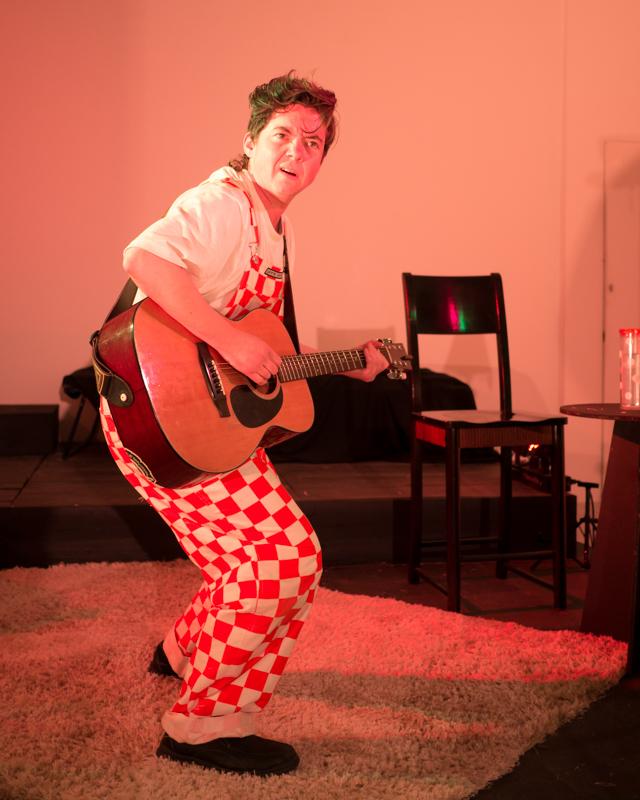
Director Linda Kash has taken what is inside Em Glasspool’s head and allowed a selection of memories and images  (gathered together, written & memorized by Glasspool) to inhabit a performance space with breakneck physicality and vocal diversity that is both hilarious and heartbreaking. The current full production (after a successful workshop production last spring) fills a third of Evans Contemporary and integrates itself into the blank white rectangular room with a simple and extremely functional set by Gabe Robinson. Robinson’s multi-levelled environment creates a simultaneous openness and containment through the use of several connected all black spaces that throw the performing body into sharp focus. The playing area becomes a classic example of the power of contrasting colour and functional shapes that the performer can rely upon as they traverse the stage and find diverse physical phrasing for each narrative act.


There are moments when the performer’s expertise at traversing and suddenly lying upon various expanses of the stage enhance the intensity of the narrative, keeping audience members engaged through a skillful combination of emotional courage and physical agility.
Kash’s  dual role as director and voiceover for various subconscious characters ranges from cartoon like Big Boy utterances to a well crafted Sigmund Freud persona - all cleverly punctuated by a personified onstage lamp. Esther Vincent’s lighting occupies both small and broad strokes that beautifully support the overall sense of inhabiting a playing space fully. Lighting complements expressions of intimate narrative and opens up as these moments ultimately reach outward toward a larger sense of the issues at hand. Original compositions, mixed with a touch of Hank Williams, composed, sung and self-accompanied by Glasspool, add a wonderful contrast to the  sixty-five minute spoken monologue.
The beautiful and poignant song Fallen Bird creates a perfect denouement as the narrative moves toward a climactic apology so crucial to ongoing recovery from addiction and mental health trauma. Followed by another original song, after a section of empowered lament, Glasspool’s creation, Resist the Resistance, simply and concisely tells a musical story about just how difficult the day to day process of keeping on track can be. Earlier in the show the original story/song Markdale/Glenelg Township becomes a crucial remembrance of things past that continue to inform the present. This sung tale evokes a sense of how specific incidents early in life can take hold, possessing both bitter humour and familial chaos that follows the subject throughout his life. 

Requiem: An act or token of remembrance.I will never forget the experience of severe psychosis. I will never forget daily hopeless deranged addiction. I will never forget friends no longer in this living plain. This is a requiem - an act of remembrance - of events in my life, and of people that have touched my life.

Playwright Em Glasspool (program note)

As a self-styled requiem filled with a comedy and pathos that is injected with Glasspool’s sense of playful language, the title and many of the written lines employ rhyming and puns that sustain the intensity with a lightness and a power that co-exist with very effective performative intent. As Kash says in her director’s note, “This is not an easy story. Takes courage to tell. It’s been a great privilege to be on the journey and I hope its telling leads to good things. Maybe even great things.”
Ultimately the great things emerging from the final product of this solo performance become a form of ongoing catharsis and recovery for spectator and performer alike. Wreck Wee Em allows the audience to witness the pain - tinged with complex, good humoured momentum - that has taken hold of a single artist and allowed him to tell a story replete with childhood trauma, the creativity that a strong adult turns into a career, and the onset of mental health issues that continue to test the limits of personal struggles and successes. Watching Glasspool re-enact this and punctuate it with heartfelt sentiment regarding all of the characters inhabiting his mind and body evokes a roller coaster of diverse emotion. It is the kind of ‘entertainment’ that one is hard put to classify as, in fact, entertainment. It does succeed thoroughly on this level through a painful-cum-joyful and empowering sense of the artist’s creative spirit and force - “I am at my best and most well when creating theatre.” (Glasspool, program note) As a collective audience we are at our best and most well when we can see the onstage representation of personal struggle as the product of an empowered theatre act - like the many simple yet evocative utterances from Alice in Wonderland as a host of creatures, both real and fantasy-ridden, represent a mind & body trying to not run away from what is in their head. Pigs, pirates, and larger than life ‘Big Boys’ render Wreck Wee Em a strong-willed testament to the potency of art as a way of moving through, toward, and in, and out, of mental and physical turmoil. A varied and difficult road to ongoing recovery…

“Where should I go?” Alice

“That depends on where you want to end up.”  The Cheshire Cat  

(DIRECTOR’S PROGRAM NOTE)

_________________________

WRECK WEE EM 
AT EVANS CONTEMPORARY 
UNTIL SEPT 30 
- 2PM ON SEPT 30, 

8PM ALL OTHER PERFORMANCES -

Monday, September 24, 2018

GERTRUDE AND ALICE (INTERVIEW WITH DESIGNER SHERRI HAY)

Thursday, August 23, 2018

THE LAST WEEKEND OF THE SUMMER - BOOK REVIEW


“What are men to rocks and mountains."   Pride and Prejudice, Jane Austen


Cottage country, in Ontarian terms, has become a cross between a Stephen King novel and a daytime soap opera. Soap opera characters often retreat to the lake laden countryside in order to escape from problems that ultimately come to a head in a frequently familial fashion, dredging up old quarrels and unearthing traumatic secrets. Peter Murphy’s engrossing take on a family in the throes of nostalgic grudge-bearing memories lies somewhere between the psychological thriller aspects of King’s world and the romantic soapy proportions of say, The Young and the Restless - moving into Austen’esque ramifications on a broad literary scale.


Murphy’s characters certainly range from quite young to mid-middle and well within quite old verging on finale. But they all reside steadfastly, with attractive physical and emotional variations, within the eternally restless domain that close relations often inhabit on a daily basis. The heterocentricity of this realm is broken nicely in a provocative intersectional manner as one family member and their new partner confront eternal family issues as well as their own neophyte phobias regarding relationships evolving within degrees of welcoming and unwelcoming milieus. No one ever quite reaches the proportions of a Margaret Atwood’ian ‘Wilderness Tips’ form of surreal realism, but they wander close - often veering toward a somewhat arresting collision with taboo and dubious titillation.


An absent patriarch, with devastating war stories in tow, looms over the proceedings and careens, through memory and reminiscence, in and out of the narrative through conversational and descriptive prose sections. This provides a strong psychological base for the variety of problems each family member encounters. The somewhat unwelcome return of a present/absentee patriarch creates the central suspense element of the overall story as all else surrounds and circles him. Murphy deftly handles this cottage carousel of multi-narrative within a single tale.


At the centre of the cast sits Gloria - in all her complicated matriarchal glory. Gathering her family together quickly becomes a puzzle to be gradually solved as the page turning saga unfolds. Why are we here? Who is joining us? Why did ‘he’ get invited? It begins as a bit of a battle of the sexes until one discovers that the battle may have already been fought and the spoils - both emotional and physical, with hints of economic outburst - have yet to be negotiated and distributed.


Perhaps one of the most fascinating aspects of this 218 page journey, through a land of lakes and latent comeuppance, is the way in which Murphy juggles the minds of men and women and finds a curious and satisfying balance between the ‘sins’ of the male creature and the ways in which the females involved behave in response to their ‘manly’ cohorts - simultaneously taking responsibility for, and thwarting, complicity. One section, in a simple yet revealing manner, shows the differences, the similarities, the contradictions and the intersections that bring people together and drive them apart in surprisingly semi-equitable yet saddening, bittersweet ways -

He had come back, all right, and he had apologized, but he was the one who got to be gracious about it. He had asked for forgiveness for his part in all that had gone wrong and never once alluded to her transgressions. She had wanted to talk about them - she wanted to hear him say that he forgave her for all of that, but that was never going to happen now. And she knew why: in all the time they had been together, she had never once allowed him to reproach her. When he had tried, she had rushed headlong into a frenzy of self-condemnation, twisting everything he said into sharp barbs that she would flagellate herself with.


No one gets off easily in ‘The Last Weekend of the Summer.' But they all get to partake in this humid Ontarian ritual that includes barbecues, boat rides, maternal wisdom, and a myriad of escapades that the author organizes in an extremely engaging and moving way.


Murphy’s style takes anyone who has experienced the drama, the comedy, the romance, and the heartbreak of a weekend in the country, back to the roots of a cottage mentality and an emotional landscape that possess a kind of Jane Austen grandeur in a contemporary setting. His writing forgoes the lengthy metaphoric nodes of masculinity concealed in Austen’s famous passage,1 but makes up for it with direct conversational confrontation and understandable volatility in his characterizations.


When Elizabeth, in Pride and Prejudice, travels to the lake district of her own homeland and exclaims, “What are men to rocks and mountains” she exposes the simultaneous repulsion and attraction to all that is monumental in nature and emotion - lamenting her own struggle with the entwined socio-economic relationships of the late 1700’s - revolution and land distribution in the background of a larger European picture. The early machinations of the first two decades of the 21st century make for a subtle background as The Last Weekend of the Summer takes timeless themes and creates a detailed set of family relationships - crafting them into the complex interactive stories that both separate and keep close relations together.


Murphys’ other novels, including Lagan Love and Wandering In Exile, embrace a fascination for discontent within familial and romantic realms, revealing a broad scope of imagination ranging from Irish mythology and politics, to Canadian immigrant experience as it encounters old world religion and socio-political strain within international and provincial regions. The Last Weekend of the Summer embraces a simpler structure as it brings a cast of characters together within a single commodified pastoral setting, yet moves their associations outward toward a vast urban context.


Ultimately a fine end of summer read - moving into fall - at times leisurely, at times thought provoking journey that might be lavishly pored over on a dock, in a Muskoka chair (Adirondack

page2image29896
for other regionally named sitting devices of similar structural import - http://www.ournorthernhomestead.com/muskoka-vs-adirondack/) - or in a tethered canoe with cans of beer, or thermoses of whiskey sours, bouncing in a cooler as one contemplates one’s own place within the cottage laden universe.

David Bateman - Toronto, August 2018 


___________________________________________________________

1 Pride and Prejudice, Jane Austen - chapter IV volume 2 - Chapter 27 -
“...what delight! what felicity! You give me fresh life and vigour. Adieu to disappointment and spleen. What are men to rocks and mountains? Oh! what hours of transport we shall spend! And when we do return, it shall not be like other travellers, without being able to give one accurate idea of any thing. We will know where we have gone -- we will recollect what we have seen. Lakes, mountains, and rivers shall not be jumbled together in our imaginations; nor, when we attempt to describe any particular scene, will we begin quarrelling about its relative situation. Let our first effusions be less insupportable than those of the generality of travellers...’'