Thursday, September 1, 2022


Artwork “Stewardess Fight” by Kirsten Johnson 
@kirstenjohnson_art_film kirstenjohnson.com

O, had the monster seen those lily hands
Tremble like aspen leaves upon a lute 
And make the silken strings delight to kiss them,
He would not then have touched them for his life.
Or had he heard the heavenly harmony
Which that sweet tongue hath made,
He would have dropped his knife and fell asleep...

Titus Andronicus, Shakespeare, Act 2,Scene 4


______________________________

Alongside the intense violence that marks Shakespeare's critically acclaimed, frequently maligned play, there is the trademark beautiful and startling poetry that has become his signature trait as a playwright of extreme poetic capabilities coupled with intense and violent murder enactments. The many graphic killings in the play reaches a peak in the character of Lavinia. An especially brutal incident is replayed as the ravaged body is viewed and pontificated upon with exquisitely arranged words and images form nature. In the hands of Sky Gilbert, the body being poeticized and grieved upon is a complex and re-arranged portion of the text, given to a character who does not speak the words in the original, thus becoming an overtly and extremely successful example of post-modern adaptation that adds new life to a very complicated text. The "lily hands...like aspen leaves" refer to severed fingers, revealing the bard's ability to take even the most gruesome of acts and make them somewhat palatable through a kind of brutalizing beauty - like nature. Making the gruesome palatable comes across in Gilbert's adaptation through simple stylized props representing gore, and skilful performances that begin with a high camp entrance and gradually move into the spoken, conversational tones that serve Shakespeare's contemporary audiences so well.


Elley-Ray Hennessy enters in the first scene in a kind of Rocky Horror, Sally Bowles, Cruella DeVille costume persona and manically measured physical poise, speaking lines with an animated camp intensity that draws you immediately into the character's enraged state. Gradually she joins the other cast members in a heightened yet metered conversational tone that allows the poetry to find a rhythm that will take us through the many scenes of violence, lament, and revenge.

Some have insisted that the original was a parody - Shakespeare's attempt to match-cum-mimic the very popular and bloody revenge plays of his contemporaries. He has been accused of "mocking and exploiting Marlowe", and it has been suggested that the best director for Titus Andronicus might be Mel Brooks. Sky Gilbert rises to the occasion and becomes a skilful and clever director for this bloody tragedy, bringing out the comedy, the horror, and the supposed parody in an engaging blend of stylized forms. 

The final scene gives pink balloons a poignant and comic presence as spectators are asked to join the cast in the outdoor space, alongside a parking lot, to watch the final moments take a signifying plunge into the hideous beauty of the central plot. The blue of the mid evening sky and the solemn playfulness of ascending air-filled hearts punctuate the closing moments as the audience descends back into the black box playing space.

                   Elley-Ray Hennessy as Tamora (Queen of the Goths and later Empress)

Standout performances by Veronica Hurnik (Narrator/Saturninus/Young Lucius/Nurse) and Augusta Monet (Lavinia 1) reveal the necessary additions and alterations to the original script that Gilbert has expertly inserted, bringing the audience into a world of observation and delineation as the director/playwright creates a mesmerizing take on the ways which violence can become an aspect of unmanaged fear and unbridled lust. 

                                       Elley-Ray Hennessy, Augusta Monet, Max Ackerman


                                                                  Veronica Hurnik 


George Alevizos' as Lavinia 2

Elley-Ray Hennessy's Queen of the Goths and George Alevizos' Lavinia 2 create intense moments of great expression and presence that consistently demands engagement, and instills great pathos and rage. Max Ackerman and John Humeniuk as the sons add varied masculine prowess as they skilfully insert bumbling, hapless personalities into the action.


                                     l-r - Joe Humeniuk,  Veronica Hurnik, Max Ackerman

Ray Jacildo as Aaron the Moor (Tamora's lover)  creates powerful land poetically charged presence with his eloquently delivered lines and his agile physical presence. More physical entanglement might have been made of the connection between him and Tamora, adding what appears to be a slightly absent sexuality in a play all about lust, blood, power, and revenge. And yet, there are some titillating homoerotic moments that come to a gruesome end.


                                             Ray Jacildo as Aaron the Moor, (Tamora's lover)


 (rear) Ray Jacildo as Aaron the Moor, (Tamora's lover) (front) Elley-Ray-Ray Hennessy (Tamora)

Brian Smegal's Titus is an understated, emotionally complex performance that gives the title character a kind of complicated and engaging shallow-depth, which serves perfectly Gilbert's notion that Shakespeare was trying to tell his audience that plays do not need a message, or 'depth', or justification. They simply need to instil something, be it fear and loathing or delight in parodic gore - satiric bloodthirstiness in the hands of a gruesome cast of characters hell bent on causing as much mayhem as humanly possible. Which is precisely what happens in this production, with the aid of Glibert's original narration that, in the hands of a skilful and sympathetic narrator (Hurnik) makes for a diverse and frequently environmental evening of theatre. 

At one point the narrator guides the audience into a basement area for a brief scene where Titus contemplates and endures the infamous fly killing scene with manic grace and a violent exit back to the main playing space. Youtube links accessible through cell phones are provided for any spectators who cannot go into the basement area, providing yet another intriguing element to the drama.
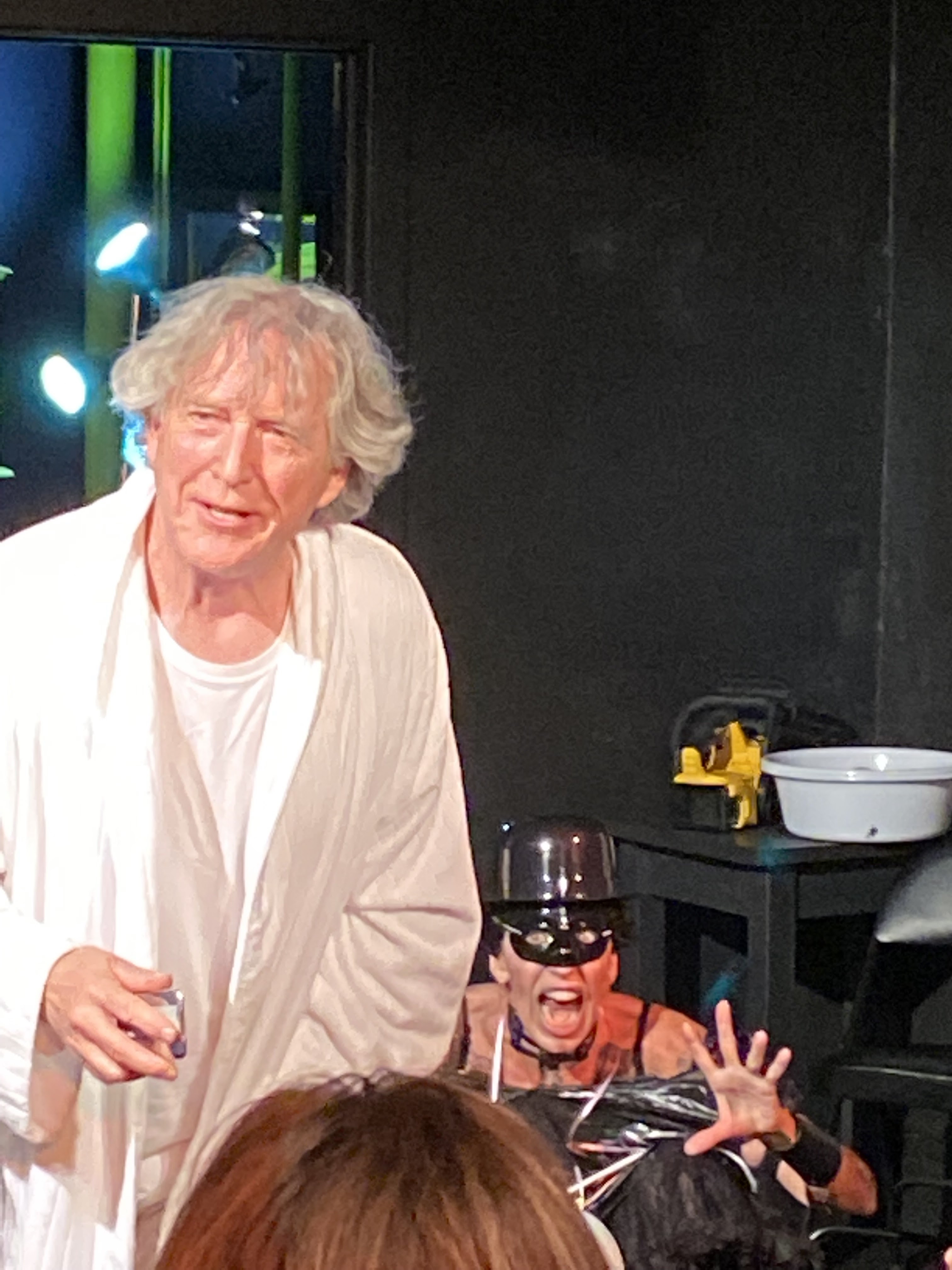

                                Brian Smegal as Titus Andronicus (a noble roman general)


And set them upright at their dear friends' door
Even when their sorrows almost was forgot,
And on their skins, as on the bark of trees,
Have with my knife carved in Roman letters
'Let not your sorrow die, though I am dead.'
Tut, I have done a thousand dreadful things
As willingly as one would kill a fly;
And nothing grieves me heartily indeed
But that I cannot do ten thousand more.” 


                                                                                    ― William Shakespeare, Titus Andronicus

And thus ends/begins the old and the new - Shakespeare's penchant for the blood and guts of beautiful and unsettling drama. Mixing comedy, tragedy, violence, and tender poetic rants-cum-meditations on the beauty and the terror of human nature. And the new - Sky Gilbert's innovative preoccupation with the study of the iconic bard in a rigorous and enlightening attempt to instil new life and energy into the work of one of the most produced playwrights in the history of theatre.

Max Ackerman, Ray Jacildo, Elley-Ray Hennessy, John Humeniuk and George Alevizos in ‘Who’s Afraid of Titus?’


                WHO'S AFRAID OF TITUS

 
RUNS AT THE RED SANDCASTLE THEATRE (922 QUEEN STREET EAST) UNTIL SEPTEMBER THIRD


Monday, November 22, 2021

FIVE ANGELS ON THE STEPS


Beginning with the dancer lounging, at times precariously, on a long modernist-like couch'ish shape comprised of yellow and red octagons, Kathleen Rea (dancer) and Newton Moraes' (choreographer) conspire to bring their new work,
Five Angels On The Steps into diverse, at times harrowing, frequently delicate and classical realms.


Although there are moments when the collection of varied segmental, musically accompanied interludes may seem to long for more haunting shapes, fully augmented by Sharon DiGenova's brilliant lighting effects, the red &yellow octagonal forms are most effective when the recorded narration regarding skeletal formations and corporeal sensation are accompanied by a musically framed, recorded voiceover that becomes a poetic movement combining scientific terms and a rhythmic commingling of spoken word and factual data. 

One section where the dancer applies red tape to the octagons utilizes these somewhat anomalous shapes to good effect and becomes a jarring battle between five identical props that  provide a simultaneously sombre and playful stage conglomeration. 


Nearing the end of the piece, atop one of the octagons, in sharply distilled, tightly focused lighting, and  surrounded by a drum inflected soundscape, Rea is at her most vibrant and rigorous, befitting a finale for this deeply moving, endlessly engaging sixty minutes of movement inspired by a near death experience. 

The beautifully arranged collection of choreographic moments, facial expressions, lilting limbs and a skeletal partner, make for what ultimately becomes a dance theatre journey, ending in a kind of chamber music scene where both skeleton and human body face each other full on for a final movement of love, death, and corporeal acknowledgement - allowing for five octagonal angels, one skeleton, and one dancer to come to terms with the unresolvable spectre of mortality, out of body experience, and that ongoing battle with our physical selves and our earthly lives that angels may comfort us within as they inhabit their dual roles as guardians and fatal companions.


A complex, moving, and haunting new work that ran at the Wychwood Barns TYT theatre from November 19th to November 21st.


for program details see;


Thursday, November 4, 2021

 Monsterpiece & Tramps Like Us 


Steve Keil & Paul Bellini bring us two distinctly different novels 

with similar themes in their recent books


Oh, baby  this  town rips  the  bones from your back

It's a death trap, it's a suicide rap

we gotta get out while we're young

Cause tramps like us, baby we were born to run

Yes, girl, we were


                                                            Bruce Springsteen, Born to Run


Summer is long gone and fall is in the balance, so let’s take a moment to remember some of our favourite summer reads. I read Zoe Whittal’s The Spectacular, Jordan Tannahill's The LIsteners, am still moving through Brad Frasers wonderful memoir, just finished Michelle Berry’s 9/11 semi-thriller (Everything Turns Away), am continuing to occasionally immerse myself in Elena Ferrante's The Lying Lives of Adults, and have just under a hundred pages left of Colm Toibin's The Magician. I'm fickle. Sometimes I have to start a book all over again because I left it alone for too long in order to dive into something else. I'm planning on plunging into Sky Gilbert's I, Gloria Grahame any day now.


But rather than reviewing any of them at length at this particular petticoat juncture, I want to focus on two wonderful local novels that entertained me wildly during the late summer heat waves when I chose my outdoor time carefully for fear of sun stroke, or worse, a blowjob in a back alley on a humid late summer evening. I haven’t done anything like that in years - not since youth, and the middle decades following, that left me satiated and happy to live on the memories of a thrilling sex life. But why ramble mindlessly on about sweltering days long gone. Well, memories of sex and all its encounters, in hidden, frequently dank urban spaces, and the corners of cosy bars, are enticing parts of Paul Bellini's  Monsterpiece and Steve Keil's Tramps Like Us.


While Bellini's title speaks directly to the particular length and girth of a favoured body part, Keil's title takes on a more prosaic tone culled from the lyric of Springsteen's iconic restless tale of a “runaway America dream.” Both novels are set in periods not so far from each other. Keil's structure takes on a seasonal tone beginning n the summer of 1998, chronicling the intersecting lives of various gay men in Toronto's Church/Wellesley neighbourhood, and venturing into gay suburban respites in upscale areas of London Ontario and semi-conjugal kitchens in Guelph.


Set in the same neighbourhood of Toronto as Keil's book, Bellini  focuses on three connected characters, moving from summer through to Christmas. An occasionally gay, frequently straight hustler-cum-porn actor, and the man and woman who become precariously involved with him, intersect throughout the book in an unconscious game of hide and seek that offers up some prime sex scenes that reveal the writers knack for describing a particular setting in titillating detail that punctuates the sexcapades, in one instance, with a nostalgic, almost camp, comic ending conjuring visions of classic porn settings -


At one point, when Alvin coincidentally looked into the lens while his shaft was deep in Renatos hole, Perry froze the image and jerked off to it.


            Then he went to sleep, wishing he could wake up in a sun-dappled 18th century hayloft.                                                                                                                           (p123)


Lively lines create vivid descriptions that lure us into webs of popular culture references and concisely drawn porn settings as sexual playgrounds for marginalized trysts. After a rendezvous in a theatre back alley a main character finds solace in a a cosy hearth and home scenario;


"It came fast, the sky changing like a drag queen changing between sets” 


– leading quickly over the course of a three page chapter to a wonderfully indirect Judy Garland citation after the sex has happened and the satisfied participant wanders “home to chill out with his new kitten, Baby Gumm. (p29)


Both novels negotiate, in brisk and lively prose that is quick to engage and never let go, the frequently conflicted, frequently joyful interactions between people living in a bold & vibrant neighbourhood. Bellini never shies away from creating characters and intervening narration that speaks directly of specific types, shapes, sizes, etc, crafting characterizations that are simultaneously unsettling, precariously hilarious. soothingly sexual - all  examples of the writers unwavering and uncompromising eye for human detail and forthright observational intimacy.


Keil embarks on somewhat more dramatic narratives woven into the lives of journeys he describes on the back cover as A tangled web of friendships, mistakes and assorted mixed drinks.” He describes, early on, a scene in a bar that indirectly conjures contemporary moments watching Canada's Drag Race in a crowded drinking/drag establishment on Church - subtly revealing that queer activities change over the decades and yet, at times, bear striking resemblances to each other as a sense of community through popular culture has, and continues to thrive, in various queer day and night spots. But for Keil and his characters, in 1998, it becomes The Price Is Right being watched in bars by eager patrons - a kind of consumerist drag race of its own brand, replete with bevies of coveted prizes rather than gorgeous bedecked queens competing for fame and top dollar. By the end of his narrative, however, Keil lands some of his primary characters in “the first warm weekend of the post vernal equinox” in a welcoming home on Gloucester Street with a drag breakfasty/brunch in full swing, not so unlike some  of the activities we enjoy in the Church/Wellesley area some twenty years later.


Both writers have taken similar themes and given their own unique and engaging take on aspects of queer identity two decades ago. Monsterpiece and Tramps Like Us are great reads for anyone interested in reliving and/or taking an intimate glimpse into particular times in a community that continues to mount and re-mount the hunks and the hurdles, the highs and the lows, of a thriving, at times stumbling, queer neighbourhood during challenging times. 


Decidedly more pornographic with a light comic edge, Bellini treats us to a fast ride through 181 pages of heartbreak, sex, connect, disconnect, and camaraderie. Keil clocks in at 214 pages, illustrating the complexities of love, loss, connection and re-connection among a group of friends trying to make it in the city and in the regions as they reconcile their queer lives with the lives some of them never quite choose to leave behind, all the time noticing the delightful details marking the culture they populate, from The Price Is Right to Richard Burton and Popeye's "spinach eater meat hooks".


Vibrant images, intimate connections, pictures, frozen in time, of an iconic Toronto neighbourhood.


_______________________________________


Monsterpiece & Tramps Like Us are available at;


https://www.amazon.in/Monsterpiece-Paul-Bellini-ebook/dp/B098WLTZL3

https://www.barnesandnoble.com/w/tramps-like-us-steve-keil/1139430287

_________________________


also find Steve Keil's poetry collections at Barnes and Noble & Amazon:


Tuesday, November 2, 2021

in the headlights . . . artist statement

for virtual viewings of my current exhibit see link below - for live visits to the gallery at 276 Dundas Street East DM me here on Facebook and we can setup a viewing - gallery hours will be thursday to sunday, two to six - please message first to set up an appointment


IN THE HEADLIGHTS - perhaps not


In a recent series of paintings entitled Abstract Impersonations I attempted to give abstraction a specific narrative. In some of the works I added text from various poems I have written over the past several years. The presence of textual language, painted into a field of often vertical strips of vibrant colour, suggested mood and tone. For example - “alone in the half light of my kitchen / i am haunted by dishwater” from my 1990's solo performance piece Salad Days, embodies the simultaneously haunting yet lyrical discontentment felt by the speaker in the performance and intimated by sharp intense oranges streaked with narrow black, pink, turquoise and yellow strips in the painting.


for images of the paintings from ABSTRACT IMPERSONATIONS go to;

https://atelierludmila.com/david-bateman-abstract-impersonations/


In another painting a similar mood and tone are suggested, through a similar technique, but the absence of text leaves any supposed narrative up to the viewer. Viewing all of the works together in a single exhibit may lend this somewhat conflicted domestic narrative the ability to bleed into other paintings, suggesting an over-arching sense of the seemingly mundane yet haunted kitchen task that only a dishwasher can help to assuage.


Perhaps not.


Nevertheless, I am constantly drawn in and out of this play between narration and abstraction, and my current exhibit. In the Headlights continues my quest for meaning and collaboration between words, fields of colour, and images. As i suggested in the artist statement for Abstract Impersonations, any given viewer, any number of viewers, may stand in front of any given abstraction and find a multitude of images within the same space in the same field, like gazing into clouds and finding poodles, snakes, and wind gods blowing cumulus bursts into the stratosphere. The absence of text however opens up the field - the sky - and allows for individual and varied perceptions to roam and to fly.


As i began the canvasses for the current showing of eleven new paintings and four older pieces I had no idea where I was going, beyond the over-riding urge to apply paint to the canvas in abstract strips of colour using painters tape and acrylic substance. A few years ago an exhibit entitled Just Paint began my pre-occupation with flinging paint around in a sometimes measured, sometimes splatter-like Pollock'esque manner. I just love paint and its ability to be flung into a variety of positions. Pollock on the other hand, I both love and grow tired of his dominant position, like dishwater – perhaps.


Once I finished the mixture of measured splattering and random taping I was feeling discontented, like I do when I wash dishes by hand. It begins as a welcome chore and ends in exhaustion and a sense of necessary yet somewhat hollow achievement. Alas, the existential plight of the unhappy home maker. I am not an especially unhappy homemaker, but there are moments of weariness around my continuing efforts to stay afloat in a sea of murky intention and an increasingly self aware world frightened by its own reflection and inner workings. I could begin with an exploration of the sustainability of acrylic matter on a floundering planet, but will save that for another artist's statement.


Well, that was a bit heavy handed.


So I give you In the Headlights, abstract fields of colour marked, in over half the paintings, by a visual image of a saying I was haunted by for years, and in middle age, before I moved into old age, haunted further by a now deceased loved one who described himself to me as “a courtesan caught in the headlights.” [1]


At his celebration of life in New Orleans three years ago, amongst a bevy of his ex-lovers, all eager to tell stories of his life, with them, I
was tempted to read a very sexual poem about him where the courtesan metaphor appears. But I was uncharacteristically bashful, and ultimately thought better of my brazen disclosure on that very warm, sunny, funereal afternoon in the Faubourg Marigny among tears, laughter, friends, boyfriends, and grieving blood relatives who may not have appreciated the imagery.  Perhaps they would have loved to hear about his perfectly formed penis and his sex life, with me.


Perhaps not.


But as I finished these paintings I felt discontent again, and wanted something in the middle of those fields of colour to speak to my life, and possibly the lives of others in an open ended, interpretive fashion - like memory and past emotion. For some reason the image of a deer came into my consciousness, and then a few days later, coincidentally, I was watching HBO, and during an episode of the recent series American Rust, there was a scene of a deer caught in the headlights of a vehicle that came to a sudden stop just in time to avoid tragedy. I photographed the screen image and then created a hand drawn replica of the image, constructed a cardboard silhouette, and applied the image to each canvas. And at some point during the process I thought of my beautiful friend, his self-professed courtesan status, and his tragically shortened life, in middle age, in a beautiful home, in a beautiful and conflicted city ravaged by history and weather, graced by art and culture.


But what of Venice and her people when the kissing had to stop[2]


Currently we all live in a global culture intensely aware of so many troubling issues - being caught in the headlights or our own disarray. In my life gender and sexual identity have been sharply focussed

upon in oppressive - gradually moving into liberating - ways of seeing and believing. Various identities in this country, and the ways in which they have been marginalized, even destroyed, and then revisited and regained by degree - revitalized in the midst of a pandemic that brings us all together in conflicted and collaborative - but not always cooperative - ways.


We are not all in the same boat, as some have tried to argue, but we may all be in the headlights, by degree, in various ways, being asked to examine the positions we have held – and held onto - and continue to hold within this vast abstraction we call a country.


The metonymic ways in which a single image can attempt to shed light upon...


Perhaps not.


[1]From the poem Stella – Invisible Foreground, David Bateman, Frontenac Press Calgary, 2005

[2] Paraphrased wildly from the 14th stanza in  'A Toccata at Galuppi's – from Robert Browning's 1855 collection 'Men and Women'


__________________________________________________________


Monday, October 25, 2021


Sky Gilbert's current theatre/cabaret offering, at the fabulous Chez BonBon on Queen East, is a rollicking interrogation of our current dilemma regarding the many modes of human behaviour we are treated to, and perhaps mistreated by, during pandemic times. The series of loosely connected scenes, performed by a cast of three gifted performers, tackles not only our current covid pandemic predicament but also the much earlier – and ongoing – social/sexual tragedy of AIDS. Indirectly related issues including addiction and gender identity surface throughout and make for a form of thought-provoking, comical satire that at times evokes degrees of poignant reflection in the hands of a talented ensemble.


Keith Cole opens the show with an energy packed, highly nuanced rhyming monologue very indirectly based on a much traveled 'camp' song that was revised, sung by Clifton Webb, and used in the 1929 musical sketch revue that inspired Gilbert's version of The Little Show. Gilbert adds a decidedly – yet subtly - more political edge to his take. Originally, the song that inspires the opening monologue, was titled I Love to Lie Awake in Bed (1920's), with music by Arthur Schwartz and lyrics by Lorenz Hart (a camp song they wrote together as young men when they worked as musical and drama  directors in a camp at Brant Lake in the Adirondacks). The original brief ditty has made the rounds, in various versions, through Fred Astaire movie musicals to the Broadway show The Band Wagon, as well as a song sung by Marsha Mason and Kristy McNichol in the film Only When I Laugh in 1982 (originally a play, The Gingerbread Lady, by Neil Simon). In Gilbert's hands, and performed by Keith Cole, the song becomes a lengthy rhythmic, spoken monologue that warns yet revels in the complexities of love and its varied implications, irritations, and delights – both carnal and carnivalesque. In alluring black sequin, spandexy-like tights and a pink glittering jacket Cole enchants with a booming voice and the necessary softer tones that move him through with an essential breakneck pace. He brilliantly sets the stage for indirectly related performance sketches about love lust and some of the profound social issues that become entangled within the over-arching vessels of romance,  relationships, and outright riveting disclosures regarding gloriously unbridled sexual appetites.


As a near relation to vaudeville sketches – just over an hour – the overall piece could benefit from more distinct separations between scenes in order to cue the audience on the somewhat disconnected nature/narrative  of each sketch – perhaps a decorative vaudeville sketch poster or a silent film text projection. And yet, Stewart Borden's live piano accompaniment provides a powerful cinematic-cum-Broadway-esque pastiche that both weaves and separates the proceedings in a highly effective, lively, and engaging way.


At one point Keith Cole joins his cast mates in a memorable intervention into a conversation about varied gender and sexual identity, inserting a brief speech that chronicles the characters movement from gay, to rainbow identified, to princess warrior. This is perhaps the strongest and most scathing moment of identity satire in The Little Show. Superbly handled by Cole, with his signature highs and lows, his skill for combining campiness and realistic dialogue-delivery, the piece becomes both comical and moving as he enters in tears and deftly frolics both fearlessly and fearsomely through a speech that could have lapsed into pointless mockery had the performer not been able to skilfully tap into the simultaneously delicate and powerful gradations individuals experience when they examine and navigate their own personal movement through various forms of being, changing, and evolving in a complicated world – a floundering planet.


l-r - Veronica Hurnik, Sky Gilbert, Shaun McComb, Keith Cole


Shaun McComb and Veronica Hurnik match Cole's seemingly effortless and engaging presence. McComb embodies a varied and charming persona in characters that move from a subtly fey vocal and physical aura to a more socially neutral, yet harrowingly seductive journey in a speech about an especially conflicted parental relationship that ends with a dark satiric punch.


Hurnik is endlessly engaging to watch as she navigates addiction addled characters who never fail to see how liberal attitudes can cloud the movement from friendship to judgmental response, to women frustrated by the proclivities of lively bi-curious connections that corner her and take up more couch time than the character might have imagined or desired. And her final song, lyrics by Gilbert with original music by Borden, is a lovely and effectively punctuating finale - a subtle nod to the original inspiration where Libby Holman sang the iconic torch song, Moanin' Low near the end of Act One in the original version of The Little Show by Arthur Schwartz and Howard Dietz.


Adding to his large catalogue of theatrical offerings, Sky Gilbert has given us yet another vastly entertaining, beautifully performed, and immensely thought-provoking little show to be entertained, engaged, and politically aroused by.


_____________________________________

and as an added bonus; 

Sky Gilberts latest novel, available at Dundrun Press

https://www.dundurn.com/books_/t22117/a9781459748286-i--gloria-grahame


THE NOVEL: Denton Moulton, a shy, effeminate male professor, lives inside his head, where he is really a long-dead movie star: the glamorous Gloria Grahame, from the golden age of Hollywood. Professor Moulton is desperate to reveal Gloria’s shocking secret before he dies. Does he have the right to tell this woman’s story? Who, in fact, has the right to tell anyone’s story at all? I Gloria Grahame is a scandalous, humorous novel of taboo desires and repression. Published under the imprint Rare Machines by Dundurn Press.

“Brilliant. An important addition to Two-Spirited literature.” - Tomson Highway

“A sharp satire of these tremulous times that actually makes one laugh. It’s brave, it’s shocking, it's compelling and best of all, it’s not too long. It’s 'De Profundiis' for the beach.” - Scott Thompson

Om Sunday October 24th at 5pm Sky Gilbert shared a reading from his new novel. Following the reading attendees were able to buy the book for $22.99. 

Wednesday, October 6, 2021

AS YOU LIKE IT - CLIFF CARDINAL'S RADICAL RETELLING - CROW'S THEATRE September 22nd to October 24th 2021


WILLIAM SHAKESPEARE'S
AS YOU LIKE IT
A RADICAL RETELLING BY CLIFF CARDINAL

SEPTEMBER 22ND TO 0CTOBER 24TH 
CROW'S THEATRE

It is not the fashion to see the lady as the epilogue;

but it is no more unhandsome than to see the lord`

the prologue... As You Like It (epilogue excerpt)

When Rosalind delivers her gender commingling epilogue to As You Like It, written by a lesser known playwright (William Shakespeare), she deftly dances through iambic pentameter in an attempt to shed light upon the fluidity of gender, red wine, and men dressed as women kissing bearded meni – among other things. When Cliff Cardinal delivers his gender specific 'epilogue' in his radical retelling of As You Like It, amongst an ensemble cast of singular multiplicity and complex diversity, he frames the unofficial finale/epilogue of his 90 minute tour de force with stories about strong, proactive indigenous women, and how they participate and take action within their communities. These stories act as powerful - at times comical - frequently moving reminders that community action can become a defining force within daily struggles to stay afloat in the midst of profoundly troubling social issues.


Like Shakespearean comedy and drama, Cardinal's closing stories about women are being told by a man. But in Shakespeare, of course, the woman played by a man is dressed as a woman. Cardinal wears casual, contemporary Elizabethan-esque-ish attire giving his stage presence a subtle sense of neutral gendered fluidity as far as costume is not concerned.

*

If I were a woman, I

would kiss as many of you as had beards that

pleased me                                                                -  Rosalind, epilogue

Rosalind and Cardinal, in their respective retellings of life lived within unacknowledged sites of bodily, geographic, and national disavowal, give their audiences a double sided look into the nature of urban and rural identities.

Within Cardinal's venture into national/global geographic tragedies that might be considered 'Shakespearean' in their intensity and profound social injustices, there are many moments in this incredibly engaging performance that can be aligned with the city and the forest and all that lies between these inevitably land-based sites. In Shakespeare the city is the royal court and the forest is the forest of Arden. In Cardinal's version the city and the forest is Canada, with familial sojourns into specific locales in the U.S.

Not being able to see the larger picture -  the forest for the trees – is a primary problem in Canada when one attempts to discuss the breadth and intricacies of ongoing crimes made against indigenous sites (Canada as a singular/multiple vast indigenous site). We could start with clean water and take it from there. But let's not. Let's stop for a moment and ask, what on earth is this reviewer talking about? He is trying to talk about the history of a country as long as Cliff Cardinal is "good looking." Cardinal says as much about his own physical presence within his take on one of Shakespeare's most popular/attractive comedies.

Like Rosalind, Cardinal is a dual entity – both compassionate and wryly critical - self aware, self assured, quick to make complex, simultaneously comical and thought-provoking over-arching claims, and then skilfully able to unpack them and deconstruct the intricate and complicated histories behind them. His onstage persona is filled with charm, physical prowess, and agility as he navigates tightly conceived, subtle blocking and emotional expression that takes him from centre stage and back again throughout the show.

After all - the world is a stage, as Jacques so aptly puts it in his famous As You Like It soliloquy, and the men and women merely players. Cardinal - and his deceptive ensemble - is a truly gifted player as he entertains, enlightens, and effectively 'tricks' his audience into believing in the power of theatre as a vehicle for social change, when in fact, as he mentions slyly at the beginning of the show, social change in so many theatre productions is made possible through the support of large oil bearing entities and/or banking institutions – among other funding bodies. Bodies that are not always the friendliest of allies when it comes to claiming and saving the land that is nature's greatest alliance with all of us.

Like Duke Senior in Shakespeare's Act Two, Cardinal finds tongues on trees, books in the running brooks / Sermons in stones / and good in everything” - and yet, within those very same places he finds the corruption and crime that underlies so much of our national history.

Cardinal's radical retelling of As You Like It topples statues, ideologies, apologies, and recent theatre 'prologues' - ultimately exclaiming something along the lines of - 'well, now at least we know how easy they are to tear down.' At one point he describes himself as "not a particularly compassionate person” - and yet he does this in the context of a performance - a radical retelling - that is filled with complicated double-sided forms of compassion that boldly ask us to listen carefully and be aware that everything we hear may not be quite enough - like an epilogue, a prologue, or perhaps even a land ackn`owledgment. We need to stop hearing and seeing in over-simplified ways - as we like it – to consider and to become more attuned to the very complex nature of language, land, and ownership - and to acknowledge our parts within those vast and increasingly compromised stages.


RUNNING AT CROW'S THEATRE UNTIL OCTOBER 24TH